Labor Distribution report
The Labor Distribution report shows hours, percent of time, rate and labor cost by employee and contract, from posted entries that match QuickBooks Online.
The Labor Distribution report in WiseCost shows hours, percentage of time, rate and labor cost by employee and by contract. Run it from Reports → New Report → Labor Distribution, by payroll periods or by date range. Its numbers come from the journal entries Labor Distribution already posted, so they match QuickBooks Online.
Who can do this: an Administrator.
Who uses it
- A contractor supporting labor charges on an invoice or in a DCAA review.
- A nonprofit showing the share of each person's time and salary charged to each federal award, which is the core of time and effort reporting.
- A CPA reconciling labor cost to the general ledger.
Run the report
- Go to Reports → New Report and click Labor Distribution.
- Choose the range: payroll periods or a date range.
- Optional: filter by employee, class, location or timesheet status.
- Run it.
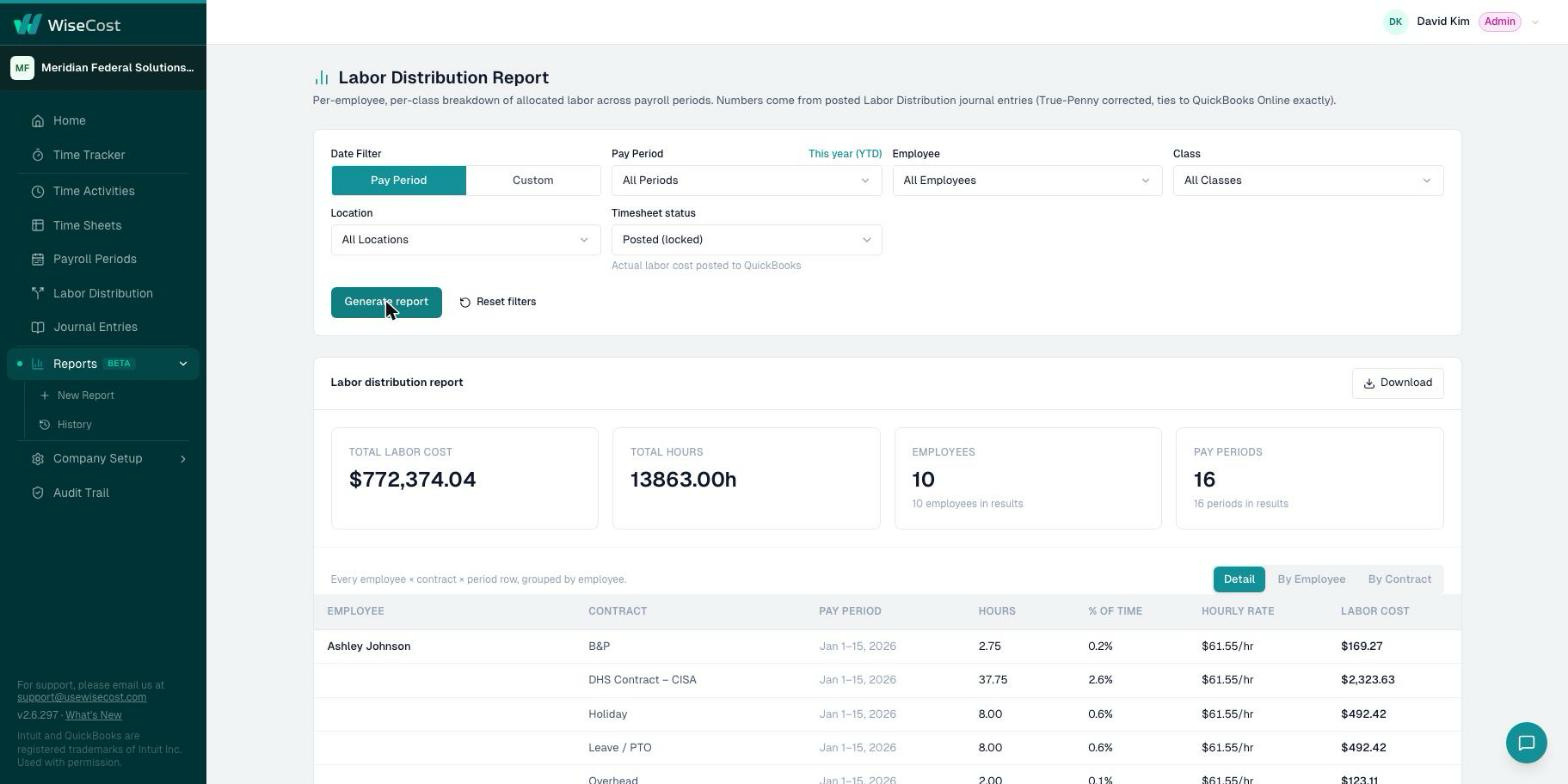
Three views
- Detail: every employee and contract combination on its own row.
- By Employee: one block per person, with their contracts and the percentage of their time on each.
- By Contract: one block per Class or Project, with the people who worked on it.
Drill down
Click a cell to see what is behind it: the time activities that make up the hours, or the journal entry lines that make up the cost.
Download
CSV, Excel and PDF. The PDF starts with your cover page. The report is also saved in Report History.
Common questions
Why do the totals match QuickBooks Online?
The report reads the journal entries WiseCost posted to QuickBooks Online, not a separate calculation.
A period is missing from the report. Why?
Labor cost appears once the period's labor distribution is posted. Check the period in Payroll Periods.
Can I see the percentage of an employee's time per grant?
Yes. Use the By Employee view.
Further reading from the WiseCost blog
Labor Distribution for Government Contractors: How It Works and Why It Matters
Labor distribution converts approved timesheet hours into contract charges and journal entries. Here's the mechanics — rates, rounding, reconciliation — and why it matters.
Reviewed by a CPA
Direct vs. Indirect Costs in Government Contracting: A Practical Guide
A practical guide to understanding and classifying direct and indirect costs for government contracts. Includes pool structures, allocation methods, and common mistakes.
Reviewed by a CPA