Bid & Proposal· · 11 min read
Is Fixed-Price the New Default for GovCon Contracts? What It Means for Your Books
Fixed-price is now the government's default contract type. Here's what changed in the FAR, why it shifts more financial risk onto small and mid-size GovCons, and what your accounting system needs to track to protect your margin.
Yes, and that changes what small and mid-size government contractors need to see in their books. The federal government now treats fixed-price as its default contract type. If you are a GovCon, more of your future work is likely to be fixed-price, which means more of the financial risk on those contracts sits with you, not the government.
The short version: under fixed-price, a cost overrun comes out of your margin, so you need to know what each contract is costing you while the work is happening, not at closeout.
This article covers what changed, why it shifts risk onto small GovCons, and what your accounting system needs to do about it.
What changed, in plain terms
On April 30, 2026, President Trump signed Executive Order 14402, "Promoting Efficiency, Accountability, and Performance in Federal Contracting." The order says fixed-price contracts with performance-based considerations should serve as the government's "default and preferred method of procurement."
The FAR Council has been implementing that shift ever since. On July 1, 2026, it posted updated Part 16 text and class deviation guidance implementing the order, effective July 15, 2026. A new FAR 16.104 requires written justification, approved at the agency head level above set dollar thresholds, before a contracting officer can use a contract type other than fixed-price.
On September 18, 2026, the Council posted a proposed rule that rewrites FAR Parts 16 (contract types), 17 (special contracting methods), and 35 (research and development contracting). For contract-type selection, it would move the guiding principles from a restrictive framework to a permissive one, giving contracting officers more room to choose a contract type as long as it promotes the best interest of the government and is not prohibited by statute. Comments on the proposal are due October 19, 2026.
The practical difference for a small GovCon comes down to who carries the cost risk:
| Cost-reimbursable | Fixed-price (now the default) | |
|---|---|---|
| Who absorbs a cost overrun | The government, within the contract ceiling | The GovCon, dollar for dollar |
| How the price is set | Negotiated, then trued up against actual allowable costs | Negotiated once, generally fixed for the life of the contract |
| Who checks your costs | Commonly the government: an accounting system review before award, then an incurred cost audit | Usually no one after the fact, so the discipline has to come from you |
Why the risk shift matters more than the paperwork
This is the part that matters most for your books: the change moves financial risk from the government onto the contractor. It is a risk transfer, not just a paperwork change.
Under a cost-reimbursable contract, the government pays your allowable, allocable costs plus a fee. If your actual costs run over your estimate, within the contract ceiling, you are still largely made whole. Under fixed-price, that safety net is gone. You agreed to a number, and every dollar you spend beyond it comes straight out of your margin. Brian Wendroff described the arrangement in our DCAA Ready webinar series, in the session on building rates:
"There's the agreed-upon amount between the organization and the government contractor to perform the work, and they just have to perform that work no matter how much it costs them."
Brian Wendroff, CPA, Co-founder of WiseCost and Managing Partner at Wendroff & Associates, CPA
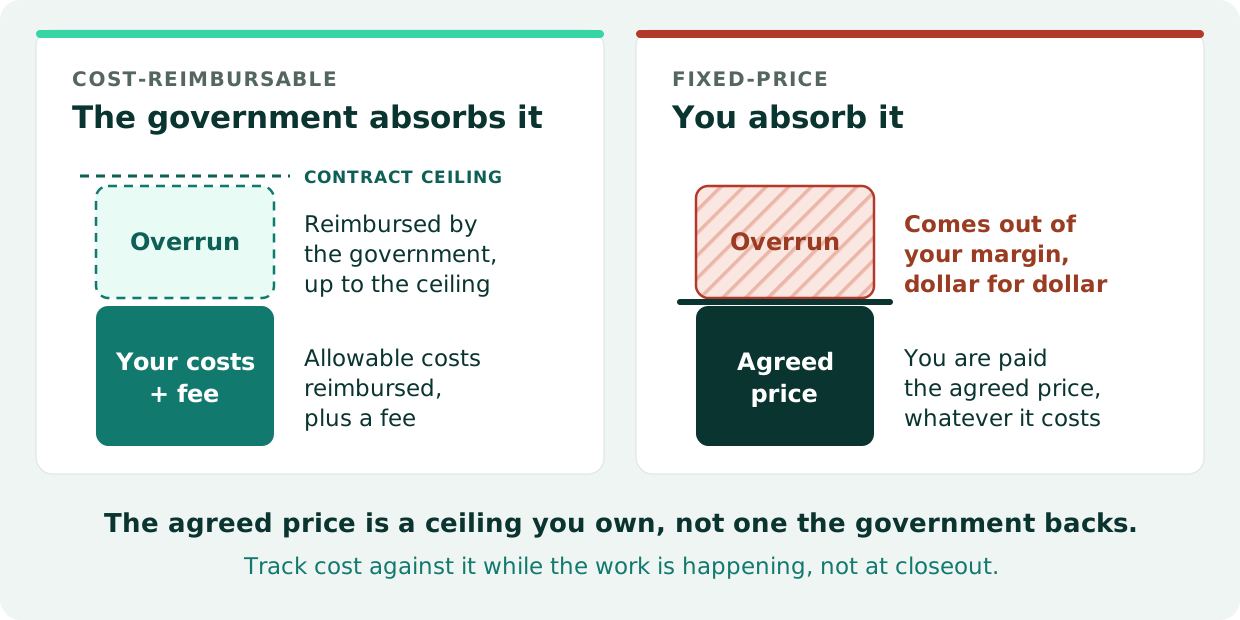
We cover the mechanics of each contract type, and how they drive your rate structure, in Cost-Reimbursable vs. T&M vs. Firm Fixed Price. The short version: fixed-price rewards a GovCon that knows its real cost before it bids and tracks that cost closely during performance. Without that visibility, a contractor is far more exposed to losing margin it cannot see.
The blind spot: most small GovCons can't see job-level cost in real time
This is not a new problem. It is one of the most common gaps in small GovCon accounting setups: a general ledger shows how the company is doing overall, but not what any single contract is actually costing.
A common assumption is that QuickBooks on its own is enough to get through a DCAA audit. Often the bigger gap is further back: job costing, the practice of tracking what each contract actually costs, is not something many new government contractors have set up yet. It is one of the first things a GovCon tends to need and one of the last things a standard accounting setup provides.
Here is why that gap costs money under fixed-price. In QuickBooks, a standard profit-and-loss report shows revenue, direct labor, and overhead for the business as a whole. What it does not show is how each contract is performing once indirect costs are allocated to it. A contract can look profitable on direct labor alone and still be losing money once its share of overhead and G&A is counted. As Brian Wendroff put it in the DCAA Ready webinar series, walking through exactly this in QuickBooks:
"This contract was profitable. Oh, okay, we're doing good. However, once indirect costs are allocated, you now see what you call fully loaded profit and loss by contract, and you can see, unfortunately, this contract is not doing well. It's losing money."
Brian Wendroff, CPA, Co-founder of WiseCost and Managing Partner at Wendroff & Associates, CPA
Brian walks through that contract in this short clip:
That is the blind spot. Most small GovCons know what they bid and what is in the bank. What they do not know, until closeout or a bad quarter, is whether the gap between those two numbers is closing or getting wider. The reason is not carelessness. A general ledger and a spreadsheet simply are not built to show job-level cost as the work happens, only once the period closes. Under cost-reimbursable work, that gap mostly showed up as a compliance risk. Under fixed-price, it shows up directly as lost margin.
The flip side is the payoff. Once you can see fully loaded cost by contract, you can actually manage it: which contracts to renegotiate, where to move resources, which work is worth chasing more of.
"Not only are you being DCAA compliant, but now you have business intelligence here. You have insight as someone who would run a government contracting organization and go, okay, I truly know how much profit my contracts are making."
Brian Wendroff, CPA, Co-founder of WiseCost and Managing Partner at Wendroff & Associates, CPA
What this means in practice
A few things matter more in a fixed-price-default environment than they did before. Open each one for the detail:
1Know your full cost before you bid, not just direct labor
Make sure your bid price covers your full overhead and administrative costs, not just the direct labor you can see. That is the number you are actually protecting. Our guides on how cost pools become rates and what a wrap rate actually is walk through how to build it correctly, and how to build rates that win government contracts puts it all together.
2Compare actual cost to your bid while the job is running, not just at the end
Check each contract's cost to date against the budget you priced it with, on a regular rhythm (for example, every pay period, when labor cost is distributed) instead of waiting for closeout. If a job you priced for a 15% margin is tracking toward 5% three months in, finding out now still leaves time to adjust staffing or scope.
3Keep daily timekeeping and labor distribution disciplined, even without a DCAA audit on the horizon
Build the habit even if you do not currently have a cost-reimbursable contract. The habit is what protects your margin; passing an audit is a side benefit. As we explain in Labor Distribution for Government Contractors, the process that converts approved timesheet hours into dollar amounts charged to a contract is what makes job-level cost visible in the first place.
4Don't assume fixed-price means DCAA is irrelevant to you
DCAA involvement depends largely on contract type, and a GovCon that is fixed-price today can move into cost-reimbursable work later, for example in SBIR and STTR programs that begin with fixed-price phases and later shift into cost-reimbursable territory. That is when an accounting system survey (the SF-1408) becomes likely. Our overview of which DCAA audit you will actually face covers when auditors get involved. Building the discipline before you need it is easier than building it under pressure.
How WiseCost helps
This is the gap WiseCost was built to close. It connects to your existing QuickBooks Online account, with no migration and no new ledger; connecting takes a couple of minutes, and QuickBooks stays your system of record. Here is what it adds, step by step, and why each piece is what makes job-level cost visible:
- Daily timekeeping by project, with manager approval. Employees enter time against the contract or task they actually worked on, and a manager approves it. This is the raw data a general ledger never captures on its own, and it is also what a DCAA auditor looks for.
- Automated labor distribution, instead of spreadsheets. Turning approved hours into the right dollar amount charged to each contract is the step most small GovCons do by hand in spreadsheets, where one broken formula can throw off a whole year. WiseCost runs that calculation automatically and builds the journal entry for you.
- A journal entry posted straight into QuickBooks, with an audit trail. WiseCost posts that labor distribution as a traceable journal entry back into QuickBooks, with an immutable record behind it. The numbers tie back to your general ledger, so there is nothing to reconstruct later.
- Fully loaded profit and loss by contract. Once direct labor and allocated indirect costs are both charged to each contract, you can finally see true profit and loss by contract, not just for the business as a whole. That is the view that tells you, while the work is happening, whether a fixed-price job is making or losing money.
The result: even a five-person GovCon can see what a specific task order is costing as the work happens, not months later when the contract closes out. For a full walkthrough of what a DCAA-ready accounting system needs to include, see our complete guide to DCAA-compliant accounting systems.
FAQ
The Bottom Line
The FAR overhaul makes fixed-price the government's default contract type, so more federal work will carry financial risk on the contractor's side. Fixed-price contracting is not new. What is changing is how much more of it small GovCons are going to see. With more fixed-price work, a GovCon needs real visibility into what a contract is actually costing while the work is happening, so a margin problem shows up in time to do something about it.
WiseCost offers a 14-day free trial, no credit card required. You can also run our free DCAA Readiness Self-Assessment to see whether your books can show cost by contract today, or book a demo to see a fully loaded P&L by contract built from your own QuickBooks Online data.