Bid & Proposal· · 12 min read
How to Build Rates That Win Government Contracts: Direct Labor, Cost Pools, and Wrap Rates
A step-by-step guide to building a government contract labor rate: from direct labor to fringe, overhead, and G&A cost pools, to a wrap rate and a fully loaded bid rate. Includes a worked example and the pricing mistakes that get bids rejected.
A government contract labor rate is built by starting with what you pay an employee per hour, then layering three indirect cost pools on top of it, and finally adding a fee for profit. Here is the full build, one layer at a time, with a single worked example carried from start to finish.
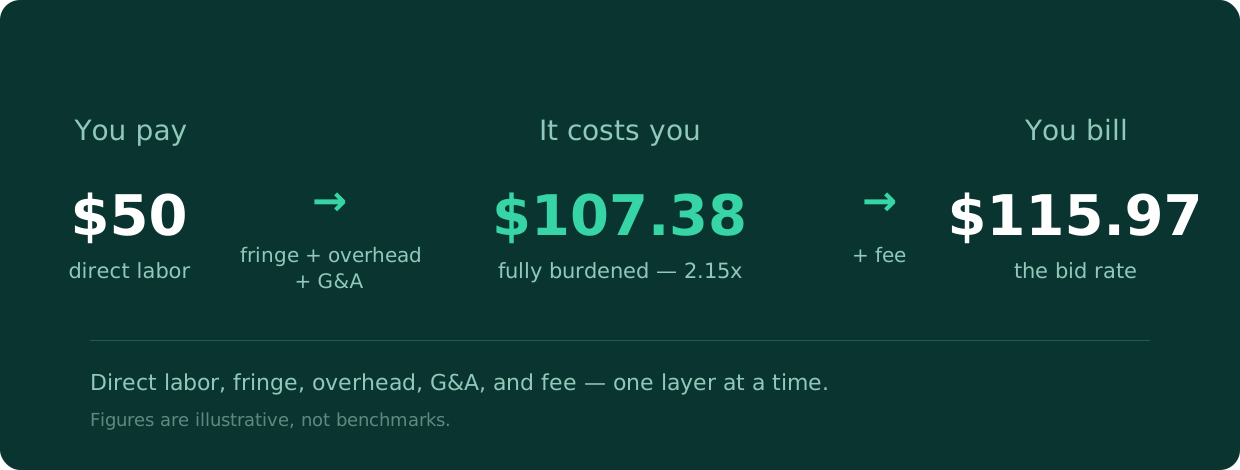
The engineer who costs you $50 an hour does not cost your company $50 an hour. By the time you can defend the number in a proposal, that same hour is closer to $107, and the rate you bill is closer to $116. That gap is not a markup you invented. It is cost you were already carrying: benefits, an office, a project manager, accounting, insurance. Building a rate is the discipline of making those costs visible, assigning them to an hour of work, and doing it the same way every time so you can defend it when a contracting officer or a DCAA auditor asks how you got there.
This guide draws on our DCAA Ready webinar series session on bid and proposal pricing, presented by Brian Wendroff, CPA, Co-founder of WiseCost and Managing Partner at Wendroff & Associates, CPA, and Paul Calabrese, a former DCAA auditor. The figures are illustrative, not benchmarks. Your own pools and bases will produce different numbers, but the method is the same.
Why the government asks for a rate at all
Whether a solicitation asks for an hourly rate or a total price depends on the contract type. When the government issues a Time and Materials (T&M) solicitation, it knows the value of an hour of a given labor category but not how many hours the job will take, so it asks for rates and applies maximum oversight. When it issues a firm fixed price solicitation, it wants a total price for a defined scope, and how you got there is your business, though you still need to know your rate to price the job without losing money.
As Paul Calabrese put it in the session, T&M "is thought of in the government as being requiring the most oversight," because the rate is fixed but the hours are not. Even on a fixed price effort, he noted, "you certainly want to know what the value of your hourly rates are so that you can put it in the proposal."
There is a second reason the number matters, and it has nothing to do with winning.
Why the build matters twice: A rate you cannot support is a rate you cannot defend in an audit. The same build that makes you competitive is the build that makes you compliant.
The three contract types, and how each uses your rate
The same rate does a different job depending on how the contract pays you.
| Contract type | Common examples | Does it ask for an hourly rate? | Audit exposure |
|---|---|---|---|
| Cost-reimbursable | CPFF, CPAF, SBIR Phase II | Indirectly, through your indirect rates | Highest. May trigger an SF-1408 accounting system review and later an incurred cost audit |
| Time and Materials (T&M) | T&M, GSA multiple award schedules | Yes, directly | Moderate. Rates evaluated up front |
| Firm fixed price (FFP) | FFP, SBIR Phase I | Not required, but you need it to price the job | Lowest. Priced up front, no cost audit after |
In all three, the rate comes from the same place: your books. The difference is who checks it, and when. Business reasons: so you do not lose money. Compliance reasons: so you can defend the number.
SBIR contracts move through this same logic as they progress. Phase I is usually fixed price. If a company advances to Phase II, or later Phase III, the award commonly becomes cost-reimbursable, which is when the SF-1408 review enters the picture. For a deeper look at how contract type changes the review you face, see which DCAA audit you will actually face.
What is actually inside an hourly rate
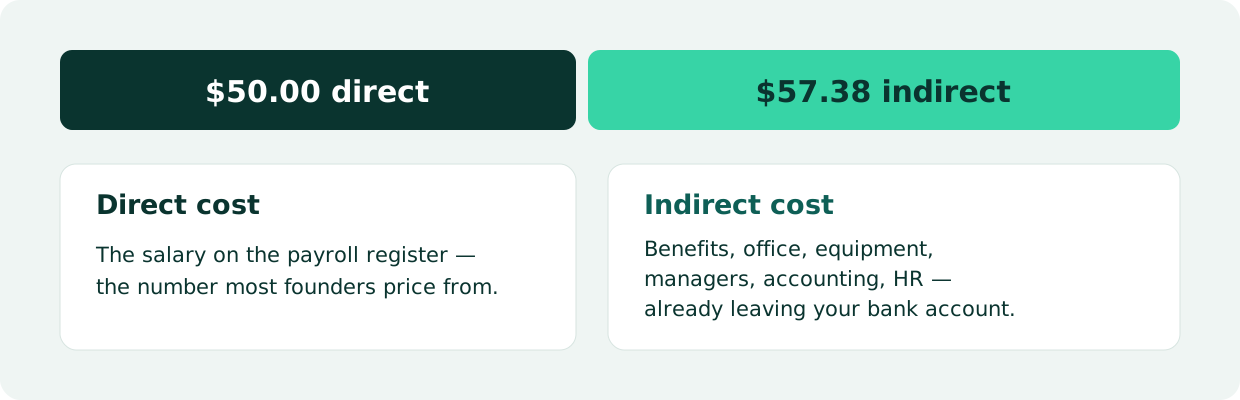
Start with the number most founders price from: the salary on the payroll register. Then remember everything that has already left your bank account to make that person productive. Health insurance and payroll taxes. The office. The laptop. The manager who runs the contract. The accountant who closes the books. That is the difference between direct cost and indirect cost, and on a service contract the indirect side is usually larger than the direct side.
Direct cost is tied to a single contract: the engineer's labor on Contract A. Indirect cost benefits many contracts or the whole company: the HR team, the lease, the audit fee. The ratio between the two is what a rate captures. If you want the classification foundation before you price, our guides on direct vs. indirect costs and the five cost pools cover it in detail.
Step 1: Direct labor
Direct labor is the starting point, and it is the easiest layer to build. Take an annual salary and divide it by the hours worked in a year.
In our example, an engineer earns a $100,000 salary and works about 2,000 hours in a year. That is a direct labor cost of $50.00 per hour.
That $50.00 is the number on the payroll register, and for most founders it is the only number in their head when they price a bid. It is also the smallest part of what the hour costs.
A note on the 2,000: it is a rounded, teaching-friendly number. The more standard full-year convention, 52 weeks at 40 hours, is 2,080 hours, and it produces a very similar result ($100,000 ÷ 2,080 is about $48.08). Either convention is defensible as long as you apply it consistently. What matters far more than which one you pick is everything that comes next.
Step 2: The three cost pools
There can be hundreds of indirect costs in a single company. Building a separate rate for each one would be unworkable, so similar costs are grouped into pools. Three pools cover most small and mid-size contractors, and each one answers a different question about why the cost exists.
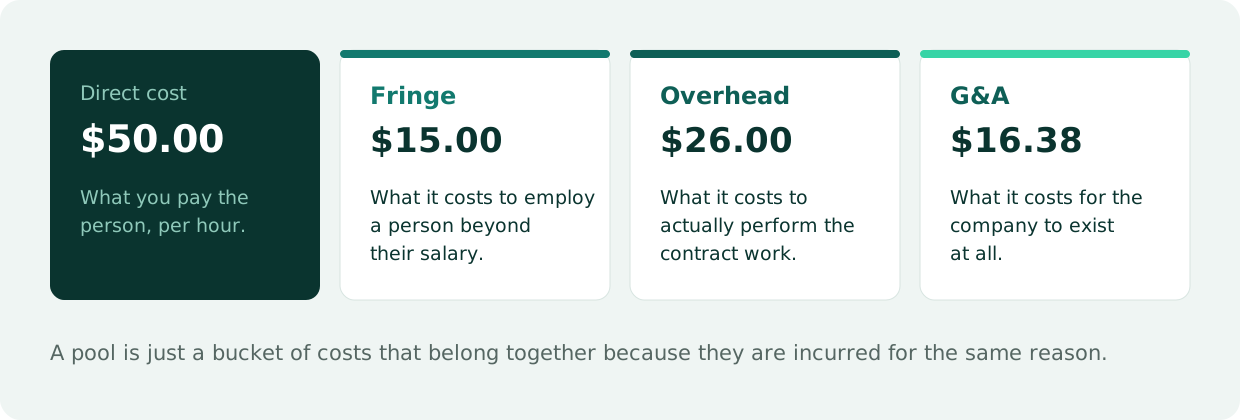
Fringe is the cost of employing someone beyond their wage. Overhead is the cost of running the work: the managers and facilities that serve many contracts but cannot be tied to just one. G&A is the cost of the company existing: the executive, finance, HR, and administrative infrastructure that benefits the entire organization. For the line-by-line detail of what belongs where, see how to classify indirect costs.
Step 3: How a pool becomes a rate
A pool by itself is just a bucket of dollars. It becomes a rate when you divide it by a base:
Rate = Pool ÷ Base
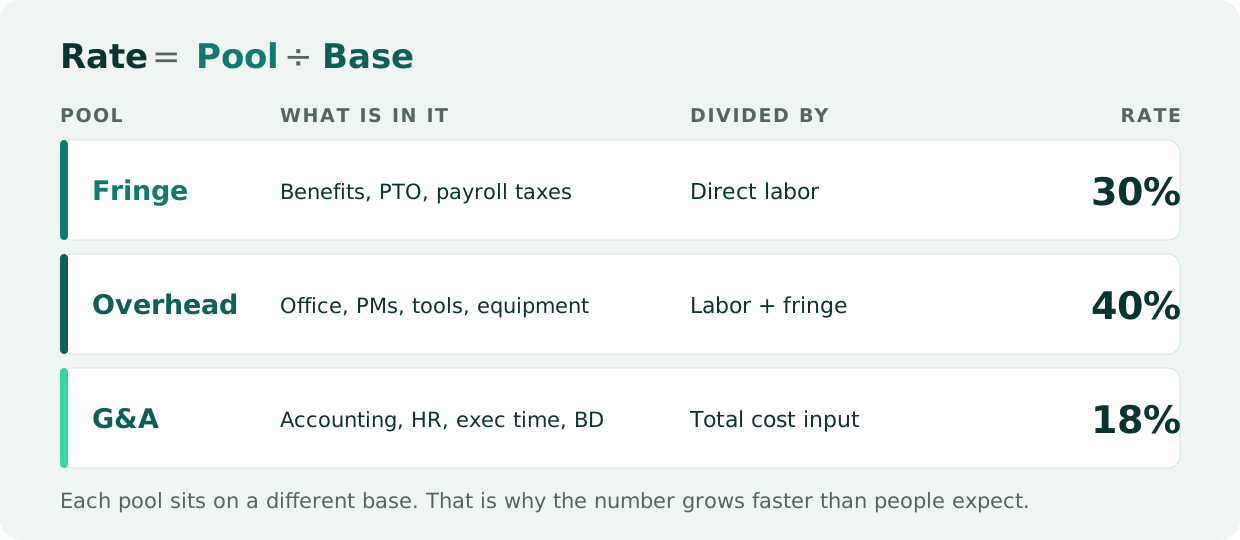
The base is the activity the pool supports. Fringe supports labor, so it sits on direct labor. Overhead supports the labor effort including its fringe, so it sits on labor plus fringe. G&A supports the whole cost of running the job, so it sits on the total cost input beneath it. Each pool sits on a different, larger base than the one before it. That is why the number grows faster than people expect, and it is the single idea most founders miss when they try to price from salary alone. We cover this cascade in depth in how cost pools become rates.
Step 4: Layering into a wrap rate
Now stack the layers. Each rate is applied to its base and added to the running cost.
| Layer | Rate applied | Applied to (base) | Amount added | Running cost per hour |
|---|---|---|---|---|
| Direct labor | n/a | n/a | $50.00 | $50.00 |
| Fringe | 30% | Direct labor | $15.00 | $65.00 |
| Overhead | 40% | Labor + fringe | $26.00 | $91.00 |
| G&A | 18% | Labor + fringe + overhead | $16.38 | $107.38 |
You pay the engineer $50.00. Once every allowable indirect cost is allocated to that hour, the hour costs your company $107.38. That is your break-even point. Charge less than that and you lose money on the work.
The wrap rate collapses those three layers into a single multiplier:
$107.38 ÷ $50.00 = 2.15x
The wrap rate is not new information. It is the same three rates expressed as one number, so you do not rebuild the whole stack every time you price a position. Hire a senior engineer at $70.00 an hour? Multiply by 2.15 and you know the fully burdened cost is about $150.50. A wrap rate of 1.5 generally signals a bare-bones infrastructure, around 2.0 is more typical, and much above 2.0 starts to hurt your competitiveness. The wrap rate excludes fee. We break down the multiplier in what is a wrap rate.
Step 5: Adding the fee
Everything up to the wrap rate is cost. A contractor is not in business to break even, so the last layer is fee, which is your profit. Build the whole stack one layer at a time:
An 8% fee on $107.38 of cost adds $8.59, for a fully loaded bid rate of $115.97. That $115.97 is what you bill. It covers the direct cost, every indirect cost, and a profit. Note that this final figure is not itself called a "rate" or a "multiplier" in the way the wrap rate is; it is simply the bid rate.
What surprises people
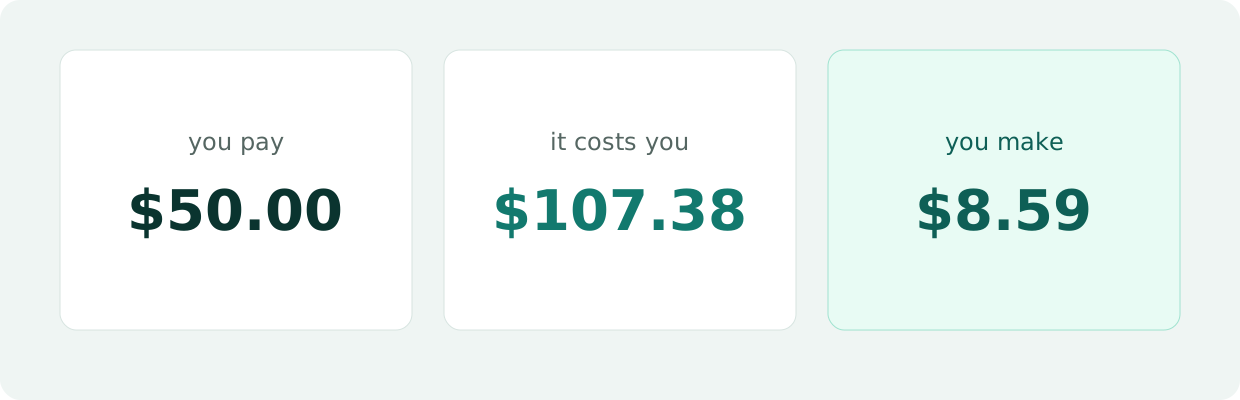
You pay $50.00. You bill $115.97. You are not making $65.97.
Everything in between was cost you were already carrying. It just never showed up on the invoice as a line item, so it was easy to forget it existed. The founders who lose money on government work are usually the ones who priced from the first column and forgot the second.
The trap: buying in and cost realism
The instinct, when a bid feels competitive, is to shave the rate to win. On government work that can backfire in two specific ways, and both are written into federal regulation.
The first is buying in, which the FAR defines as submitting an offer below anticipated cost expecting to raise the price later or to win follow-on work at higher rates (FAR 3.501). On a cost-reimbursable contract, if an agency senses you are artificially lowering rates, it can cap your indirect rates, leaving only your direct costs flexible.
The second is cost realism. On cost-reimbursement contracts, the government is required to run a cost realism analysis to decide whether your proposed costs are realistic for the work (FAR 15.404-1(d)). If your multiplier is far below everyone else's, an analyst can conclude the price is not sustainable, that you may go out of business mid-contract, and reject the proposal. Related tools an agency can use include unbalanced pricing analysis under FAR 15.404-1(g).
"I don't think that's sustainable. You may go out of business. We just don't even want to play with that."
Paul Calabrese, a former DCAA auditor, describing how the government reads a rate that looks too low
The lesson is not that low rates are illegal. It is that a rate has to be defensible, and a rate you cannot sustain is a rate that costs you the contract, or the company. We cover the full picture in what is buying in.
Before you bid: three checks
Before a rate goes on paper, three things are worth confirming:
- Your indirect rates are current and historically grounded. Rates built on last year's costs, applied to this year's bid, are how small firms quietly lose money. Small businesses see real year-to-year volatility in their G&A, and a stale multiplier does not catch it.
- You understand the competition. Market intelligence tells you whether your wrap rate is in range before you submit, not after you lose.
- You know whether teaming improves your odds. Partnering as a subcontractor under an experienced prime is often the faster path to a first award than bidding solo.
A typical government contractor with 20 to 40 employees submits more than 20 proposals a year to win one or two. Pricing discipline is what makes those attempts pay off. The full version lives in our pre-bid checklist.
Where the books meet the rate
Every number in this guide comes from your accounting system. The pools are only as clean as your chart of accounts, and the rates are only as defensible as the labor distribution behind them. That is the gap WiseCost was built to close. It connects directly to your existing QuickBooks Online, with no migration, and layers on DCAA-compliant timekeeping, labor distribution, and indirect rate reporting. You assign each account to a pool (fringe, overhead, or G&A), and WiseCost generates the rate report with the justification behind every number: which accounts fed which pool, over which base, to produce the wrap rate you price from.
Here's Brian Wendroff building a wrap rate from QuickBooks Online, in about three minutes:
FAQ
WiseCost offers a 14-day free trial, no credit card required. You can also run our free DCAA Readiness Self-Assessment to check your system against an SF-1408 review, or book a demo to see it in WiseCost.
Based on the DCAA Ready webinar series, Session 04: Bid & Proposal — Building Rates That Win Contracts, featuring Brian Wendroff, CPA (Wendroff & Associates, CPA) and Paul Calabrese, a former DCAA auditor (GRF CPAs & Advisors). Figures are illustrative and not benchmarks.