Cost Accounting· · 5 min read
How Cost Pools Become Rates: Pool ÷ Base, and Why Your Rate Grows Faster Than You Expect
You already know fringe, overhead, and G&A. This is the next step: how each pool becomes a rate by dividing it over a base, why each pool sits on a different base, and why that cascade makes your wrap rate larger than founders expect.
You already know fringe, overhead, and G&A. This is the next step: how each pool becomes a rate by dividing it over a base, why each pool sits on a different base, and why that cascade makes your wrap rate larger than founders expect.
Every government contractor eventually runs into the same wall: fringe, overhead, and G&A are easy to define as categories, but turning them into an actual percentage you can charge is a different skill. Brian Wendroff, CPA, Co-founder of WiseCost and Managing Partner at Wendroff & Associates, CPA, put the entire mechanic in one sentence in our DCAA Ready webinar series:
"You divide them by a base. So you have the pool divided by the base, and that comes up with a percentage or a rate."
Brian Wendroff, CPA, Co-founder of WiseCost
A cost pool becomes a rate when you divide the pool by a base: Rate = Pool ÷ Base. The reason a fully burdened rate climbs so much higher than a founder expects is that each pool sits on a different, larger base than the one before it. Fringe sits on labor. Overhead sits on labor plus fringe. G&A sits on everything beneath it. So the same percentages compound instead of adding.
If you still need the classification side (what belongs in each pool, and how to structure your chart of accounts), start with cost pools explained and how to classify indirect costs. This article picks up where those leave off.
The formula: Rate = Pool ÷ Base
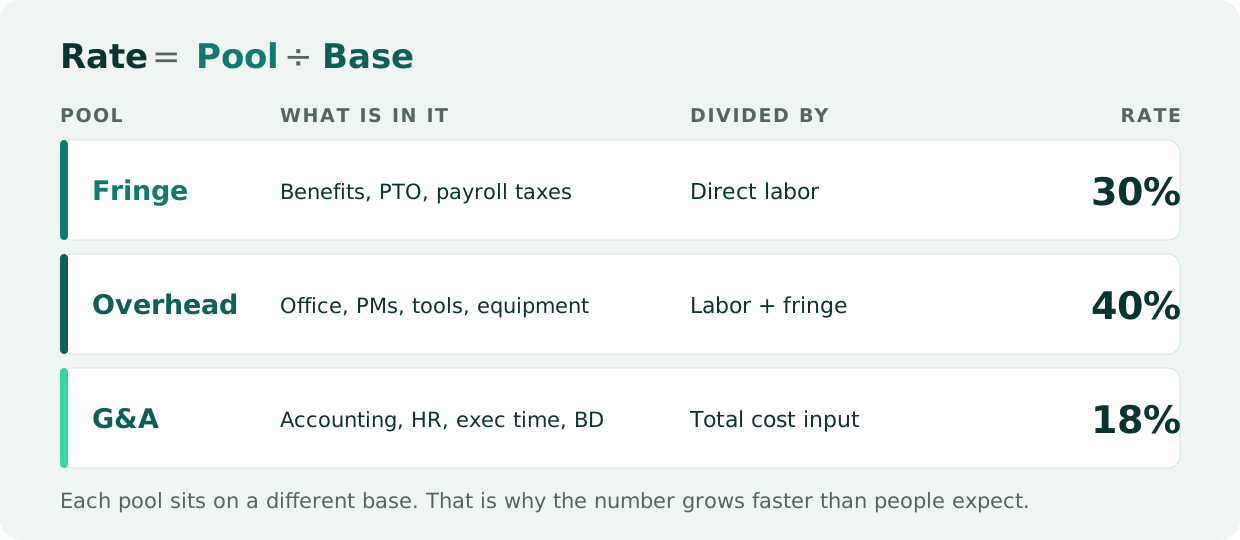
A pool is a bucket of dollars grouped because they exist for the same reason. A base is the activity those dollars support. Divide one by the other and you get a percentage: the rate.
For example, if your fringe pool holds $30,000 of benefits and payroll taxes, and your direct labor base is $100,000, then your fringe rate is $30,000 ÷ $100,000, or 30%. Every $1.00 of direct labor carries $0.30 of fringe.
The number itself is easy. The part that trips people up is the base.
Why each pool sits on a different base
The base is not arbitrary. Each pool sits on the activity it actually supports, and that activity gets larger as you move up the stack.
Fringe supports employment, so it sits on direct labor. Overhead supports the labor effort that is already carrying its fringe, so it sits on labor plus fringe. G&A supports the entire operation beneath it, so it sits on the total cost input. Each base contains the layer before it. That is the whole idea, and it is why the dollars grow.
The cascade, in dollars
Watch the same three percentages land on three growing bases.
| Layer | Rate | Base it lands on | Dollars added |
|---|---|---|---|
| Direct labor | n/a | n/a | $50.00 |
| Fringe | 30% | $50.00 | $15.00 |
| Overhead | 40% | $65.00 | $26.00 |
| G&A | 18% | $91.00 | $16.38 |
Look at overhead. It is a 40% rate, but it lands on $65.00, not $50.00, so it adds $26.00. Look at G&A. It is only 18%, the smallest rate of the three, but it lands on $91.00, so it still adds $16.38. The running cost climbs to $107.38, and the engineer you pay $50.00 an hour costs your company more than twice that.
This is why pricing from salary alone is dangerous. A founder who mentally adds "maybe 30% for overhead" to a $50.00 wage lands near $65.00 and bids into a loss. The real number is not additive. It compounds.
From cascade to wrap rate
Once the layers are stacked, you can express the whole thing as one multiplier, the wrap rate:
$107.38 ÷ $50.00 = 2.15x
Now you never have to walk the cascade again for a routine bid. Multiply any labor cost by 2.15 and you have the fully burdened cost. We cover the multiplier in what is a wrap rate, and the full build from salary to bid rate in the pillar, how to build rates that win government contracts. Figures here are illustrative, not benchmarks.
Consistency is what makes the rate defensible
Two contractors with the same total costs can build different, equally valid structures, because FAR Part 31.2 gives commercial contractors wide latitude in how they allocate. What the government does not accept is a contractor who changes structure to look more profitable from one bid to the next. Consistency and uniformity in how contractors measure and allocate cost is a core reason Congress created the Cost Accounting Standards Board in 1970. Whatever bases you choose, you have to apply them the same way every period. Consistency is not a style preference here. It is the compliance requirement.
Where the bases come from
Pools and bases are only clean if your books are. WiseCost pulls your chart of accounts straight from QuickBooks Online, lets you assign each account to a pool, and calculates each rate over the correct base, showing which accounts fed which pool and which base it landed on. For applying those rates back to each contract, see how to calculate indirect rates in QuickBooks Online.
FAQ
WiseCost offers a 14-day free trial, no credit card required. You can also book a demo to see each rate calculated from your own chart of accounts.
Based on the DCAA Ready webinar series, Session 04: Bid & Proposal — Building Rates That Win Contracts, featuring Brian Wendroff, CPA (Wendroff & Associates, CPA). Figures are illustrative and not benchmarks.