DCAA Compliance Software· · 10 min read
WiseCost vs Deltek Costpoint: How to Choose a DCAA Setup for a Small GovCon
Deltek Costpoint replaces your accounting system with a GovCon ERP. WiseCost keeps QuickBooks Online and adds the timekeeping, labor distribution, indirect rates and audit trail DCAA reviews. Here is how they differ and when each one fits.
Deltek is often the first name small contractors hear when someone mentions a DCAA-compliant accounting system. This guide is for owners and bookkeepers who are weighing Deltek Costpoint against QuickBooks Online plus an add-on like WiseCost. Both can meet the same DCAA requirements. They differ in how much of your system they replace, who has to run it, and how long it takes to get going.
The short answer
Deltek Costpoint is an ERP built for government contractors. It puts accounting, projects, time, billing and procurement in one system and replaces the accounting software you use today. Costpoint Essentials is the package Deltek offers small and growing contractors.
WiseCost, a QuickBooks Online add-on for DCAA timekeeping and labor distribution, takes the other route. QuickBooks Online stays your accounting system, and WiseCost adds the controls DCAA tests on labor: daily timekeeping by contract, labor distribution, indirect rates and an audit trail.
Both routes can meet the criteria on the SF-1408, the Preaward Survey of Prospective Contractor Accounting System that DCAA uses to evaluate whether a contractor's accounting system is adequate. The choice comes down to whether you want to replace your accounting system now, or keep it and add what it is missing.
Brian Wendroff, CPA, put the minimum bar this way:
"The minimum is that whatever procedure or process they have follows the SF-1408. So it doesn't matter if they're using QuickBooks and Excel or QuickBooks and WiseCost or [Deltek]."
Brian Wendroff, CPA, Co-founder of WiseCost and Managing Partner at Wendroff & Associates, CPA
What Deltek Costpoint is
Deltek describes Costpoint as an ERP platform built for government contracting and defense work. The capabilities it lists include accounting and financial management (with DCAA audit support, billing and indirect rate management), time, expense and workforce management, planning and budgeting, contract management from pre-award to closeout, manufacturing, and supply chain and procurement. For contractors that handle controlled unclassified information, Deltek also offers Costpoint GCCM, a hosting option it describes as meeting FedRAMP Moderate equivalency.
Costpoint Essentials is the version Deltek markets to small and growing contractors. As listed on Deltek's site in October 2026, it includes project accounting, time and expense, business intelligence, and budgeting and forecasting. It starts at $800 per month for a 10-user license, with licenses and implementation included, and Deltek states a go-live of 60 days or less.
What WiseCost is
WiseCost is a time tracking and labor cost allocation application that works on top of QuickBooks Online. Employees log time daily against contracts (QuickBooks classes or projects), approvers review the timesheets, and WiseCost distributes each period's labor cost across contracts and indirect pools, then posts the journal entry to QuickBooks Online. It also calculates fringe, overhead and G&A rates from your QuickBooks Online data and keeps an audit trail of changes to time, timesheets, labor distribution and compliance settings.
Connecting WiseCost to QuickBooks Online takes about a minute, and nothing in your books moves. For how the work splits between the two, see WiseCost vs QuickBooks Online.
Side by side
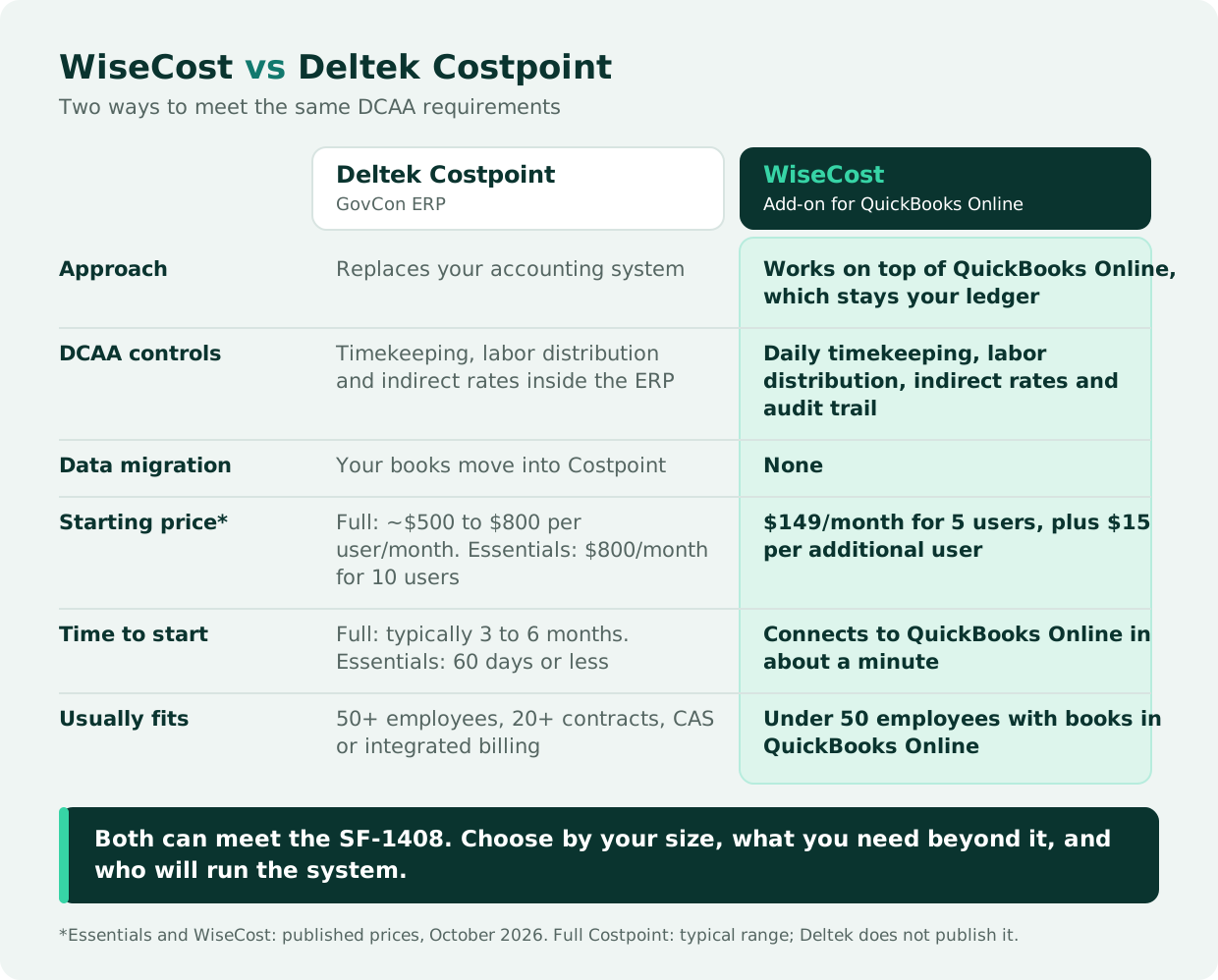
| Deltek Costpoint | WiseCost on QuickBooks Online | |
|---|---|---|
| Role in your system | Replaces your accounting system as the general ledger | Works on top of QuickBooks Online, which stays your general ledger |
| Data migration | Your books move into Costpoint | None; WiseCost syncs from QuickBooks Online |
| Timekeeping with approval | Time and expense module | Daily timekeeping by contract, with an approver and a backup approver |
| Labor distribution | Calculated and posted inside Costpoint | Calculated in WiseCost and posted to QuickBooks Online as a journal entry |
| Indirect rates | Indirect rate management inside the ERP | Indirect Rate report calculated from QuickBooks Online transactions |
| Billing and invoicing | Automated billing inside Costpoint | Invoices stay in QuickBooks Online |
| Procurement and manufacturing | Modules available in Costpoint | Not included |
| Who works in it day to day | Staff or an outside firm that knows Costpoint | Your current bookkeeper or CPA, in QuickBooks Online |
| Starting price* | Full Costpoint: typically $500 to $800 per user per month, plus implementation. Costpoint Essentials: $800/month for 10 users, licenses and implementation included | $149/month including 5 users, plus $15/month per additional user, plus your QuickBooks Online subscription |
| Time to start | Full Costpoint: typically 3 to 6 months. Costpoint Essentials: go-live in 60 days or less, as Deltek states | Connects to QuickBooks Online in about a minute; the team can log time the same day |
*Costpoint Essentials and WiseCost prices as published by each vendor in October 2026. Deltek does not publish full Costpoint pricing; that range is a typical estimate. Prices and plans change, so confirm current numbers with each vendor before budgeting.
The two list prices pay for different things. Costpoint Essentials includes a new accounting system and its implementation: your books move into Costpoint, and your team learns to work in it. WiseCost is added to the QuickBooks Online subscription you already pay for, with no migration, and your bookkeeper and CPA keep working where they work today.
When an ERP like Costpoint makes sense
- You want one system for everything. Accounting, projects, time, billing and procurement on a single platform, with one vendor and one database.
- Your operations go beyond services. Costpoint includes manufacturing, shop floor time and supply chain modules that a QuickBooks Online setup doesn't have.
- You handle controlled unclassified information and want ERP hosting built for it. Deltek offers Costpoint GCCM for that case.
- You have outgrown QuickBooks Online as a ledger, with many entities, complex billing or Cost Accounting Standards coverage on your contracts.
- You have the people to run it. An ERP works best with an in-house accounting team, or an outside firm, that knows the system.
When QuickBooks Online plus WiseCost makes sense
- Your books already work in QuickBooks Online. What is missing is turning time into labor cost by contract: daily timekeeping, labor distribution and indirect rates.
- You want to keep your bookkeeper or CPA. They keep working in QuickBooks Online, and nobody has to learn an ERP.
- You need a working system soon, for a proposal or a pre-award accounting system review. There is no migration, and your team can be logging time by contract the same day you connect.
- You are small and growing, with a handful of contracts and no need yet for integrated billing, procurement or earned value. You pay for the controls DCAA tests, not for modules you won't use yet.
Who will run the system is easy to overlook. Jordan Glaze described it for a 15-person company:
"It may be too early to move to [Deltek]. It might be hard [...] to find a good accountant that would be able to work on those books. And it's also going to be expensive. The implementation will take longer. It'll take a few months, as to where just adding some software to what you already have can be done in a week or even a couple [of] days."
Jordan Glaze, Business Development Specialist/Accountant, Wendroff & Associates, CPA
Costpoint Essentials shortens the implementation, with the go-live of 60 days or less that Deltek states. The question of who works in the system every month applies to any ERP.
DCAA evaluates your process, not the brand of your software. This short clip explains why:
How to decide
For most small contractors, three questions settle it.
How big are you? With fewer than 50 employees, and especially around a first or second cost-type contract, QuickBooks Online plus an add-on is usually the right fit; the cost and complexity of an ERP are out of proportion to what you need. An ERP starts to earn its cost past roughly 50 employees with 20 or more active contracts, or once revenue reaches $10 to $20 million and an in-house accounting team becomes affordable. DCAA Compliance Software Compared lists the full set of signs.
What contract types do you have? Whatever the type, you need to know what each contract really costs. On fixed-price work, that is how you protect your margin, as we cover in Is Fixed-Price the New Default for GovCon Contracts?. T&M and cost-reimbursement contracts add DCAA's timekeeping and labor distribution requirements, and either path can cover them. Full Cost Accounting Standards coverage on large cost-plus contracts is where an ERP starts to make more sense. More in Cost-Reimbursable vs. T&M vs. Firm Fixed Price.
How established is your QuickBooks Online setup? If your bookkeeper, CPA, payroll provider and month-end close all run through QuickBooks Online, moving to an ERP changes every one of them. An add-on leaves them where they are.
A well-configured QuickBooks Online setup with a compliance add-on can pass the same pre-award survey as a well-configured Costpoint system, because auditors evaluate the system, not the software brand. And the choice isn't permanent. You can start with QuickBooks Online and an add-on and move to an ERP when you grow, with your chart of accounts, cost pools and timekeeping practices already in place. For the wider comparison across ERPs and lighter tools, see DCAA Compliance Software Compared.
FAQ
The Bottom Line
Deltek Costpoint and WiseCost answer the same DCAA requirements from opposite directions. Costpoint replaces your accounting system with a GovCon ERP that covers far more than the SF-1408. WiseCost keeps QuickBooks Online and adds the labor controls it is missing. For a small contractor whose books already work, the question is whether you need the rest of the ERP today, or only the part DCAA tests.
Know your gaps before you compare vendors. Take the free DCAA Readiness Self-Assessment, or start a 14-day free trial of WiseCost on the QuickBooks Online you already run.