Grants & Uniform Guidance· · 14 min read
Uniform Guidance Compliance for Nonprofits: What 2 CFR 200 Requires From Your Books
A plain-English guide to what the Uniform Guidance asks of a nonprofit's accounting: award tracking, budget vs actual, internal controls, time and effort, allowable costs, and the Single Audit, and how it all works on QuickBooks Online.
If your nonprofit receives federal grants, either directly from an agency or through a state or another organization that passes the money on, your books have to follow a specific set of federal rules. Many of those rules are not about the program work. They are about whether your accounting can show, award by award, what the money paid for. This guide walks through what the regulation actually requires and how a small finance team can meet it with the accounting system it already has.
Uniform Guidance for nonprofits: the series
- 1Uniform Guidance Compliance for Nonprofits (you are here): what 2 CFR 200 requires from your books
- 2Time and Effort Reporting: the records behind salaries charged to an award
- 3Indirect Costs for Nonprofits: the de minimis rate or a negotiated rate
- 4Allowable Costs Under Subpart E: what you can and cannot charge to an award
- 5Single Audit Readiness: when it applies and what the auditor tests
The short answer
The Uniform Guidance is 2 CFR Part 200, the federal rules for grants and cooperative agreements. For a nonprofit's accounting, it comes down to five things:
- A financial management system that tracks each award on its own (2 CFR 200.302). You should be able to show, for any award, what you received, what you spent it on, and how that compares with the approved budget.
- Documented internal controls over federal funds (2 CFR 200.303). Written controls, following the GAO Green Book or the COSO framework, that give reasonable assurance each award is managed by its rules, plus a way to catch and fix problems promptly.
- Time and effort records behind every salary charged to an award (2 CFR 200.430(g)). Salaries have to follow the work people actually did, not the split in the grant budget.
- Only allowable costs charged (Subpart E). Each cost has to be necessary, reasonable, and allocable to the award, and some costs, such as alcohol or lobbying, cannot be charged at all.
- A Single Audit in any year you spend $1,000,000 or more in federal awards (2 CFR 200.501). An independent auditor tests your financial statements, your schedule of federal expenditures, the internal controls over your major programs, and your compliance with the award rules.
The Uniform Guidance does not require any particular software. Any accounting system that can track costs by award can be your general ledger, QuickBooks Online included. What a general ledger does not do on its own is record staff effort by award, have it approved, and post salaries to each award based on that effort. That piece is where many small nonprofits need help.
The practical takeaway: set up each award as its own cost center and start effort records on day one of the award. Almost every other requirement depends on those two things being in place.
Who the Uniform Guidance applies to
Federal agencies apply 2 CFR 200 to nonprofits, colleges and universities, states, local governments, and Indian Tribes that receive federal financial assistance. When your organization receives federal money through a pass-through entity, such as a state agency, you are a subrecipient and the same rules reach you through your subaward.
For-profit companies are different. Under 2 CFR 200.101, an agency may choose to apply the administrative requirements and cost principles to a for-profit recipient, but it is not automatic. That is why a small business with a federal grant, such as an SBIR award from NIH, follows the rules that agency sets out (see SBIR Grants vs. SBIR Contracts). The audit requirements in Subpart F apply to nonprofits and governments, not to for-profit companies.
The Office of Management and Budget (OMB) revised the Uniform Guidance in 2024, and the revision took effect on October 1, 2024. Two of the changes matter most to small nonprofits: the Single Audit threshold rose from $750,000 to $1,000,000, and the de minimis indirect cost rate rose from 10% to up to 15% of modified total direct costs.
What the regulation asks of your books
Most of what an auditor or a grants officer will look for traces back to a short list of sections. The table puts them side by side.
| Requirement | Section | What it means for your books |
|---|---|---|
| Identify every federal award | 200.302(b)(1) | Each award recorded with its Assistance Listing number, award number, year, and the agency or pass-through entity |
| Financial results per award | 200.302(b)(2) | Accurate, current, and complete results for each award, ready for the agency's financial reports |
| Amount, source, and use of funds | 200.302(b)(3) | Records of what came in and what it was spent on, supported by source documents |
| Control over assets | 200.302(b)(4) | Funds, property, and assets safeguarded and used only for authorized purposes |
| Budget vs actual | 200.302(b)(5) | Actual spending compared with the budget for each award |
| Written payment procedures | 200.302(b)(6), 200.305 | A written process for requesting and managing federal payments |
| Written allowability procedures | 200.302(b)(7) | A written process for deciding whether a cost can be charged to an award |
| Internal control | 200.303(a) | Controls that are established, documented, and maintained, following the GAO Green Book or the COSO framework |
| Salaries supported by records | 200.430(g) | Salary charges based on records that reflect the work performed and each person's total activity |
| Record retention | 200.334 | Award records kept for three years from the date you submit the final financial report |
Run through the same list as a quick self-check. Each question comes straight from the regulation:
Track each award on its own
Most of 200.302 depends on one setup decision: every federal award gets its own cost center in your books, with the award number, the period of performance, and the approved budget recorded alongside it. Depending on your software, that cost center is a class, a project, a fund, or a grant code.
If you use QuickBooks Online, that means a class per award. Class tracking and budgets are only available on the Plus and Advanced plans; on Simple Start or Essentials, you would need to upgrade first.
With a class per award in place, QuickBooks Online covers a good part of 200.302 with its standard reports:
- What each award spent. A Profit and Loss by Class report shows income and expenses for each award.
- Spending against the budget. You can enter each award's budget by class and run a Budget vs. Actuals report.
It has two limits worth knowing:
- Budgets follow your fiscal year, not the award's dates. An award that runs 18 months, or starts mid-year, has to be budgeted in pieces, one per fiscal year.
- Salaries land wherever payroll puts them. QuickBooks Online does not know how much of each person's time went to each award, so the salary on each class is only as accurate as the split someone entered. That part is covered in the next section.
Without a class per award, every report to an agency starts with someone rebuilding the numbers by hand.
Non-federal programs, fundraising, and general administration need their own cost centers too. They are not just bookkeeping categories. They are where staff time and shared costs go when they do not belong to an award, and an auditor will want to see them.
Salaries need time and effort records
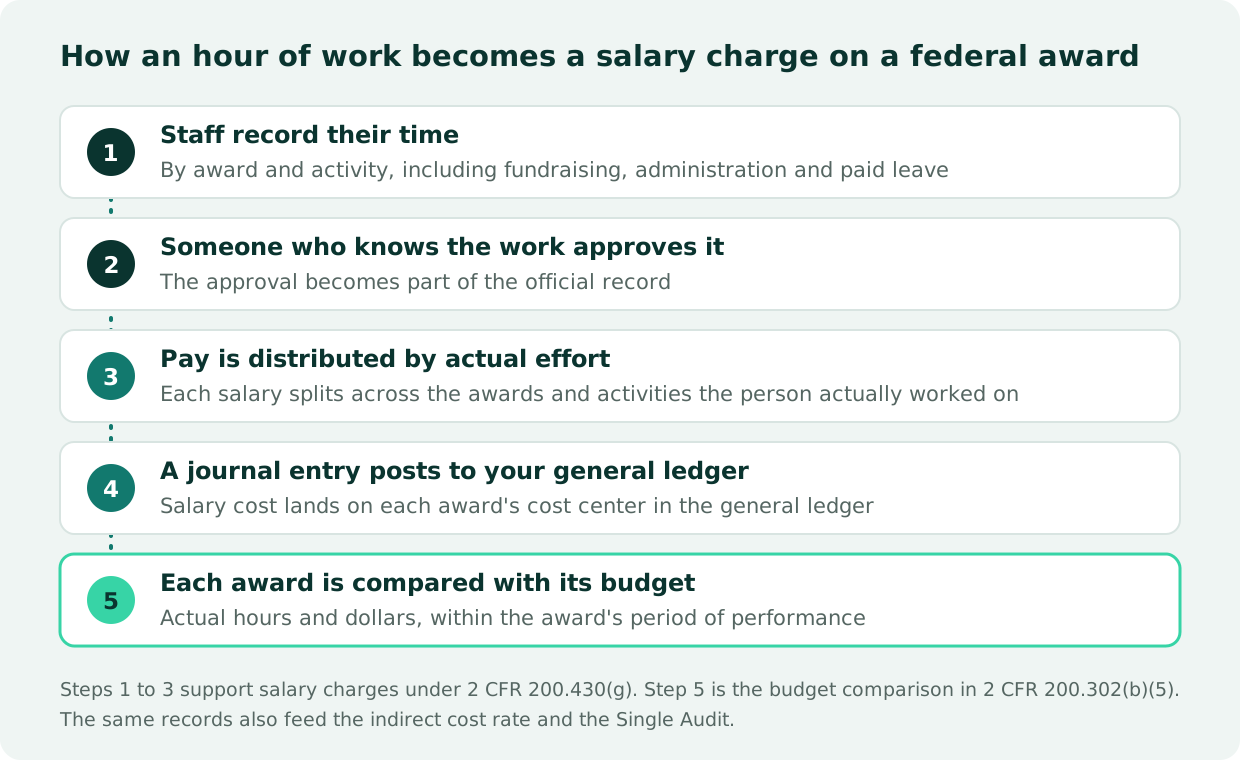
For many nonprofits, salaries are the largest cost charged to federal awards, and they need the strongest records behind them. Under 2 CFR 200.430(g), charges for salaries and wages must be based on records that accurately reflect the work performed. Those records have to reflect the total activity each person is paid for, federal and non-federal, and they have to support how each salary is split when someone works on more than one award or activity.
A budget is not enough. The regulation says budget estimates "alone do not qualify as support" for salary charges. They can be used for interim charges only if the organization reviews them after the fact and adjusts the final charge to match the work actually done.
Here is how a recorded hour turns into a salary charge on an award:
We cover the documentation standards, the after-the-fact review, and how this differs from DCAA timekeeping in Time and Effort Reporting Under 2 CFR 200.430.
Indirect costs: de minimis or a negotiated rate
Rent, accounting, IT, and leadership time benefit every program at once, so they are recovered through an indirect cost rate rather than charged directly. A nonprofit has two main options:
- The de minimis rate. An organization without a current negotiated rate may charge up to 15% of modified total direct costs (MTDC) under 2 CFR 200.414(f). It needs no documentation to justify it and can be used indefinitely, but once you elect it, you use it on all your federal awards until you negotiate a rate.
- A negotiated indirect cost rate agreement (NICRA). The rate is negotiated with your cognizant agency based on your actual costs. Under 200.414(c), all federal agencies must accept it, with exceptions only where a statute, regulation, or the awarding agency's approval allows a different rate.
Either way, a cost has to be treated consistently: the same type of cost cannot be charged directly on one award and recovered through the indirect rate on another. We compare both options, and explain what the MTDC base includes, in Indirect Costs for Nonprofits: The De Minimis Rate vs. a Negotiated Rate.
Allowable costs
Every cost charged to an award, directly or through the indirect rate, has to pass the tests in 2 CFR 200.403. It must:
- Be necessary, reasonable, and allocable to the award.
- Follow the limits in Subpart E and in the award itself.
- Be treated consistently. The same type of cost cannot be charged directly on one award and through the indirect rate on another.
- Follow generally accepted accounting principles (GAAP).
- Not be charged to another federal program, or used as cost sharing on one.
- Be adequately documented.
- Be incurred during the award's budget period.
Subpart E then sets rules for specific items, and some, such as alcoholic beverages, entertainment, and lobbying, are generally not allowable.
The practical consequence for your books is simple: costs that cannot be charged to an award need their own accounts so they never end up in an award or in the indirect rate by accident. The common traps, item by item, are in Allowable Costs Under Subpart E.
The Single Audit
A nonprofit that spends $1,000,000 or more in federal awards during its fiscal year must have a Single Audit, or in limited cases a program-specific audit, for that year (2 CFR 200.501). The audit report, the data collection form, and the reporting package are due within 30 days after you receive the auditor's report or nine months after the end of the fiscal year, whichever comes first (200.512).
The Single Audit is where everything above gets tested. An organization whose awards, effort records, and cost accounts are already clean spends its audit answering questions, not reconstructing a year. When it applies, what the auditor tests, and what to prepare are in Single Audit Readiness for Nonprofits.
A readiness plan for a small finance team
- List every federal award with its Assistance Listing number, award number, agency or pass-through entity, period of performance, and approved budget.
- Set up a cost center for each award in your accounting system (a class, in QuickBooks Online), plus cost centers for non-federal programs, fundraising, and administration.
- Separate the costs that cannot be charged to awards into their own accounts.
- Start time and effort records for everyone whose salary touches an award, covering all of their paid activity, with approval by someone who knows the work.
- Distribute salaries by recorded effort every payroll period, and post the result to the general ledger.
- Compare actuals with each award's budget every month.
- Decide on your indirect cost approach: the de minimis rate or a negotiated rate.
- Put your procedures in writing: payments, allowability, time and effort, and internal control.
- Watch your federal spending against the $1,000,000 Single Audit threshold each fiscal year.
A note on what may change
On May 29, 2026, the Office of Management and Budget (OMB) proposed a rewrite of 2 CFR Part 200. The continuing appropriations act signed on September 2, 2026 prevents OMB from finalizing that rule through December 11, 2026. Until a final rule is published, the current text, including the thresholds and rates in this guide, is what applies, along with the terms of each award.
How WiseCost fits
WiseCost is time tracking and labor distribution software that works on top of QuickBooks Online. Besides government contractors, it is built for nonprofits and other recipients of federal grants that follow the Uniform Guidance. It has a Uniform Guidance compliance preset that sets strict timekeeping controls in one step, tracks each federal award with its period of performance and budget, and posts salaries to each award in QuickBooks Online based on the hours people actually recorded, which is the core of time and effort reporting under 2 CFR 200.430. For the requirements in this guide, it covers the piece QuickBooks Online does not: recording staff effort by award, having it approved, and charging salaries from it. In more detail:
- A Uniform Guidance preset. One click sets the timekeeping controls to a strict starting point: no future-dated entries, no approving your own timesheet, employee certification before approval, and a different approver required.
- One class or project per award, with its period of performance and its budget in hours, dollars, or both. Time cannot be logged to an award outside its period.
- Total activity on every timesheet. Internal time for administration and leave, separate classes or projects for fundraising and non-federal programs, and expected weekly hours, so each timesheet reflects the whole week, not only the grant hours.
- Labor distribution. For staff who log their time, each payroll period, pay is allocated across the awards and activities people actually recorded and posted to QuickBooks Online as a journal entry.
- Budget vs Actual by Contract. Logged hours, approved hours, and actual dollars from QuickBooks Online for each award, limited to its period of performance.
Your written policies, your decisions on what is allowable, and your auditor's judgment stay with you. An auditor evaluates your system as a whole, and those pieces are part of it. The setup steps are in Setting up WiseCost for the Uniform Guidance.
FAQ
The Bottom Line
The Uniform Guidance looks long, but what it asks of a nonprofit's books is consistent: know each award, show what it paid for, support every salary with real effort records, keep unallowable costs out, and be ready for an audit once federal spending crosses $1,000,000. Your accounting system, QuickBooks Online included, can carry the general ledger. The work is in setting up each award properly and keeping effort records from the first day, so the numbers already exist when an agency or an auditor asks for them.
See how time and effort reporting works on your own books: book a demo, or start a 14-day trial of WiseCost on the QuickBooks Online you already run. No credit card required.
Official Sources
- The full regulation: 2 CFR Part 200 (eCFR)
- Financial management standards: 2 CFR 200.302
- Internal controls: 2 CFR 200.303
- Allowability factors: 2 CFR 200.403
- Indirect costs and the de minimis rate: 2 CFR 200.414
- Compensation and time and effort records: 2 CFR 200.430
- Single Audit threshold and due dates: 2 CFR 200.501 and 2 CFR 200.512
- Status of the 2026 proposed rule: BDO, What the Continuing Resolution Means for OMB's Proposed Uniform Guidance Rewrite