Grants & Uniform Guidance· · 10 min read
Allowable Costs Under Subpart E: Common Traps When Charging Costs to Federal Awards
How the Uniform Guidance cost principles decide what a nonprofit can charge to a federal award: the general tests, the costs that are never allowable, the ones allowed only under conditions, and how to keep unallowable costs out of your awards.
Many problems with grant costs have nothing to do with fraud. They are ordinary expenses that ended up on the wrong award, or on any award at all: a staff lunch with wine, an hour of fundraising inside a program salary, a cost incurred a week after the award ended. This guide is for anyone who approves or codes expenses on federal awards and wants to know which costs are safe to charge and which ones are traps. For the full set of requirements, see Uniform Guidance Compliance for Nonprofits.
The short answer
The cost principles are in Subpart E of 2 CFR 200 (sections 200.400 to 200.476). A cost can be charged to a federal award only if it passes two layers:
- The general tests in 200.403. Every cost must be necessary, reasonable, and allocable to the award, follow the limits in Subpart E and in the award, be treated consistently, follow generally accepted accounting principles, not be charged to another federal program, be adequately documented, and be incurred during the budget period.
- The rule for that type of cost. Sections 200.420 to 200.476 set rules for specific items. Some costs are never allowable, some are allowable only under conditions or with prior approval, and some depend on your own written policies.
The terms of each award can add limits on top of both layers.
The practical takeaway: give unallowable costs their own accounts and their own place in your time records. A cost that is never coded to an award cannot end up on one, or in your indirect cost rate.
The three tests that trip people up
Most of 200.403 is mechanical. Three tests take judgment:
- Reasonable. A cost is reasonable if it does not exceed what a prudent person would incur under the circumstances at the time (200.404). Market prices, sound business practice, and your own written policies all count. An expensive option is not automatically unreasonable, but it has to make sense for the award.
- Allocable. A cost belongs to an award in proportion to the benefit the award receives (200.405). A cost that belongs to one federal award cannot be moved to another to cover a funding shortfall or to avoid a restriction.
- Consistent. A type of cost must be treated the same way everywhere. If a cost is recovered through your indirect rate, the same kind of cost cannot also be charged directly to an award (200.403(d)).
Three kinds of costs
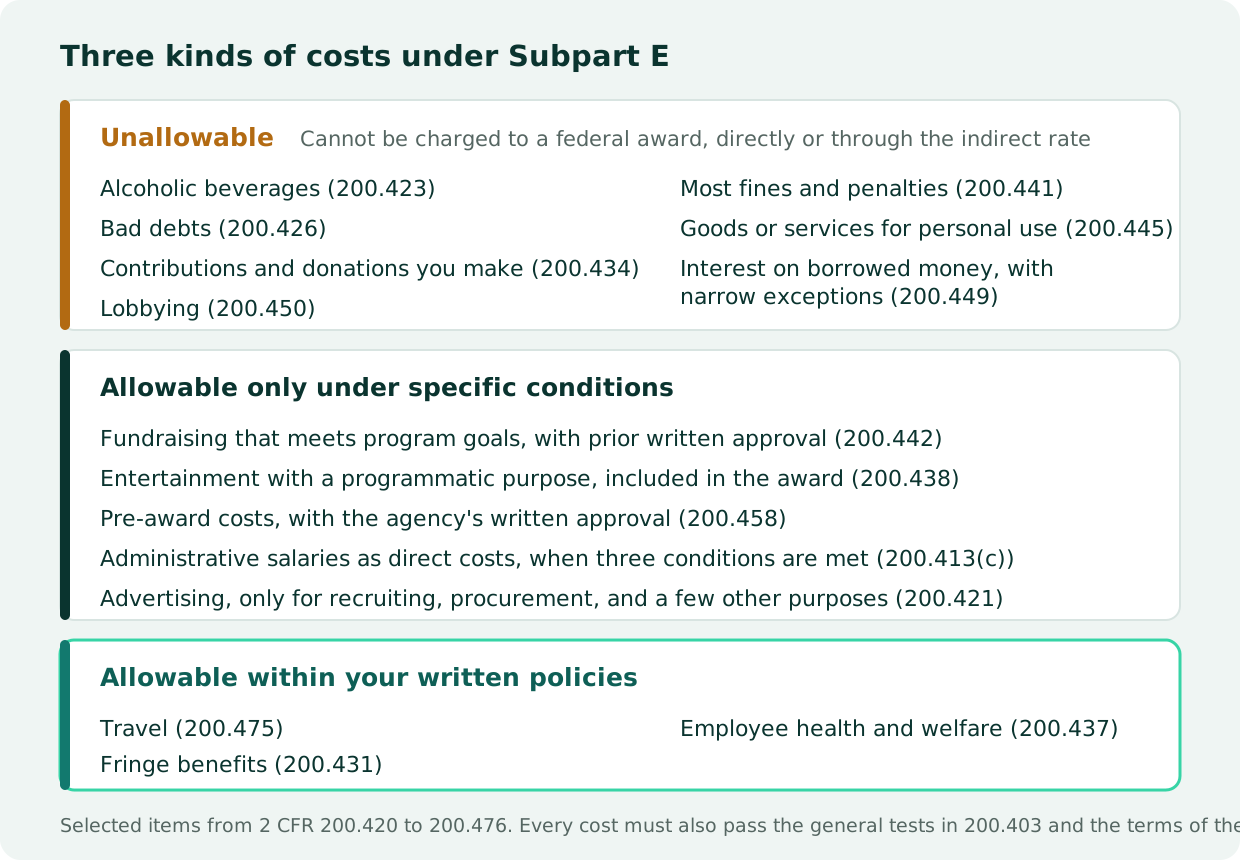
Costs that are never allowable
| Cost | Section | What the rule says | Where it can slip in |
|---|---|---|---|
| Alcoholic beverages | 200.423 | Unallowable | Event and meeting catering, receptions |
| Bad debts | 200.426 | Uncollectible debts and the costs of collecting them are unallowable | Write-offs posted to a program account |
| Contributions and donations | 200.434 | Donations your organization makes to others are unallowable | Sponsorships and gifts to partner organizations |
| Fines and penalties | 200.441 | Unallowable, except when incurred to comply with the award or approved in writing in advance | Late payment penalties, tax penalties |
| Goods or services for personal use | 200.445 | Unallowable, even if reported as taxable income to the employee | Personal items bought on an organization card |
| Interest | 200.449 | Interest on borrowed money is unallowable, with narrow exceptions for financing capital assets | Line of credit interest while waiting for reimbursements |
| Lobbying | 200.450 | Unallowable, with added restrictions for nonprofits | Staff time spent lobbying, inside a program salary |
Organized fundraising is unallowable too, with one exception covered in the next section. Staff time spent on fundraising or lobbying is the trap that is hardest to see, because it hides inside a salary. Under 2 CFR 200.430(g), time and effort records have to support the split whenever someone does unallowable work alongside allowable work. See Time and Effort Reporting Under 2 CFR 200.430.
Costs allowed only under conditions
These are not banned, but each one needs something specific before it can be charged:
- Fundraising (200.442). Organized fundraising, such as campaigns and soliciting gifts, is unallowable. Fundraising that meets the federal program's objectives is allowable only with the federal agency's prior written approval.
- Entertainment (200.438). Allowable only when it has a specific and direct programmatic purpose and is included in the federal award.
- Pre-award costs (200.458). Costs incurred before the award starts are allowable only if they would have been allowable after the start date, and only with the federal agency's written approval.
- Administrative and clerical salaries as direct costs (200.413(c)). Normally indirect. They can be charged directly only if the work is integral to the award, the people can be specifically identified with it, and the cost is not also recovered through the indirect rate.
- Advertising and public relations (200.421). Advertising is allowable only for specific purposes, such as recruiting staff for the award, buying goods and services for it, disposing of surplus materials, and program outreach the award requires, such as recruiting participants.
When the award terms or a section of Subpart E calls for prior approval, get it in writing before you spend. Under 200.407, you can also ask the agency for approval in advance when you are unsure whether a cost is allowable.
Costs that depend on your written policies
For some costs, the regulation sends you back to your own policies. Without one, you either fall back to federal limits or have nothing to show the auditor:
- Travel (200.475). Lodging and subsistence are allowable up to what your written travel policy allows in your regular operations. Without a written policy, the federal travel rates apply. Airfare is allowable up to the basic, least expensive unrestricted class offered by commercial airlines, with limited exceptions.
- Fringe benefits (200.431). Allowable when they are reasonable and required by law, an organization-employee agreement, or your established policy.
- Employee health and welfare (200.437). Costs for improving working conditions, employer-employee relations, employee health, and performance are allowable when they follow your established written policies, and they have to be spread equitably across all activities.
The financial management standards also require written procedures for deciding whether a cost is allowable (200.302(b)(7)). An auditor testing allowable costs can ask to see it.
Unallowable costs and your indirect rate
Unallowable costs cannot reach an award through the back door either. If your indirect cost pool includes alcohol, fundraising, lobbying, or other unallowable costs, part of them is being charged to every award through the rate. They have to be excluded from the pool, whether you use a negotiated rate or the de minimis rate. See Indirect Costs for Nonprofits.
Setting up your books to keep them out
- Create separate accounts for unallowable costs in your chart of accounts, such as alcohol, entertainment, fundraising, lobbying, and fines, so they are never mixed with program or administrative costs.
- Give fundraising and other non-federal activities their own cost center, so staff time and costs have somewhere to go other than an award.
- Code every expense to an award or activity when it is entered, not at the end of the year.
- Write down your allowability procedures, including who decides on unclear costs and when you ask the agency for prior approval.
- Check costs against the award's budget period. Costs incurred before the start date need approval; costs after the end date generally are not allowable, apart from administrative closeout costs allowed under 200.403(h).
A note on what may change
On May 29, 2026, the Office of Management and Budget (OMB) proposed a rewrite of 2 CFR Part 200 that would also revise rules on cost allowability. The continuing appropriations act signed on September 2, 2026 prevents OMB from finalizing that rule through December 11, 2026. Until a final rule is published, the current Subpart E and the terms of each award are what apply.
How WiseCost fits
WiseCost is time tracking and labor distribution software that works on top of QuickBooks Online. Besides government contractors, it is built for nonprofits and other recipients of federal grants that follow the Uniform Guidance. It has a Uniform Guidance compliance preset that sets strict timekeeping controls in one step, tracks each federal award with its period of performance and budget, and posts salaries to each award in QuickBooks Online based on the hours people actually recorded, which is the core of time and effort reporting under 2 CFR 200.430. For allowable costs, it keeps staff time on fundraising and lobbying recorded apart from your awards.
Whether a cost is allowable is a decision for your organization, your CPA, and your grants officer. What WiseCost provides, on top of the QuickBooks Online you already use, is a way to keep unallowable staff time off your awards:
- Fundraising and lobbying as their own class or project, so staff record that time separately from the awards.
- Every hour has to go somewhere. With expected hours required, a timesheet cannot be submitted until it covers the person's whole week, so time spent on fundraising or lobbying has to be recorded, not left out.
- Approvers who know the work. A program manager can approve their team's timesheets, which is where an hour coded to the wrong award can be caught before it is posted.
- Salaries posted by recorded time. For staff who log their time, Labor Distribution posts each person's pay to QuickBooks Online across the awards and activities they recorded, so fundraising time lands on the fundraising class, not on an award.
Costs other than salaries, such as catering, alcohol, or fines, are recorded in QuickBooks Online. The separate accounts described above are where they belong.
Setup steps are in Setting up WiseCost for the Uniform Guidance.
FAQ
The Bottom Line
Subpart E looks like a long list, but it works in two layers: every cost passes the general tests in 200.403, and then the rule for its type. A handful of costs are never allowable, a few need conditions or prior approval, and several depend on written policies you may not have yet. The safest setup is the simplest one: separate accounts for unallowable costs, a separate cost center for fundraising, time records that show where every hour went, and written procedures for the cases in between.
See how staff time on fundraising and programs stays separate on your own books: book a demo, or start a 14-day trial of WiseCost on the QuickBooks Online you already run. No credit card required.
Official Sources
- The cost principles: 2 CFR Part 200, Subpart E
- Factors affecting allowability: 2 CFR 200.403
- Reasonable and allocable costs: 2 CFR 200.404 and 2 CFR 200.405
- Prior written approval: 2 CFR 200.407
- Fundraising: 2 CFR 200.442
- Travel: 2 CFR 200.475
- Status of the 2026 proposed rule: BDO, What the Continuing Resolution Means for OMB's Proposed Uniform Guidance Rewrite