SBIR & STTR· · 8 min read
Getting Paid on a Cost-Reimbursable SBIR Phase II
How invoicing works on a cost-plus-fixed-fee Phase II: what you can bill, how billing rates and the fee fit in, and what happens to your rates after the fiscal year ends.
A firm-fixed-price Phase I pays an agreed price. A cost-reimbursable Phase II works differently: the government pays back the costs your books show you incurred, plus a fee. For a small Small Business Innovation Research (SBIR) company, that turns the accounting system into the billing system. This guide covers how those invoices are built, what you can bill, and what happens after the fiscal year closes.
The short answer
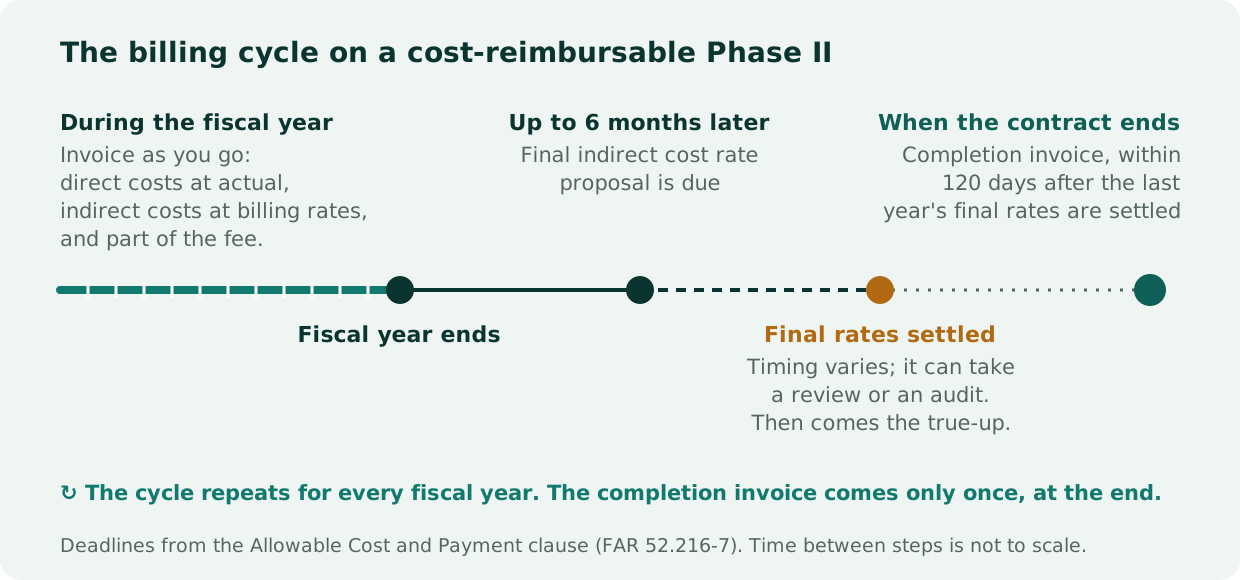
On a cost-plus-fixed-fee Phase II, you invoice as the work progresses for allowable costs recorded in your books: direct costs at actual amounts, indirect costs at provisional billing rates, and a share of the fixed fee. Under the Allowable Cost and Payment clause (FAR 52.216-7), a small business can be paid more often than every two weeks. After each fiscal year, you submit a final indirect cost rate proposal within six months, and what you billed is trued up to your actual rates.
The practical takeaway: on a cost-reimbursable award, you can only bill what your books have recorded. A month that is not closed is a month you cannot invoice accurately.
What goes into a cost-reimbursable invoice
Each invoice, often called a public voucher or cost voucher, claims costs for the period and cumulative costs to date on the contract. A typical one is built from these pieces:
| Line | Where the amount comes from |
|---|---|
| Direct labor | Approved timesheet hours on the contract, times each person's actual pay, posted to the general ledger through labor distribution |
| Other direct costs | Materials, equipment, travel, subcontracts, and consultants recorded against the contract |
| Fringe, overhead, and G&A | Your provisional billing rates applied to their bases |
| Fixed fee | The share of the fee the contract schedule allows for the period |
| Cumulative totals | Everything billed to date, which lets the government check the invoice against the contract's funding |
The format and submission channel are set by the contract. Department of Defense contracts, for example, generally require invoices to be submitted online through the department's electronic invoicing system, Wide Area WorkFlow (DFARS 252.232-7006), where a cost-reimbursable invoice is filed as a cost voucher.
What you can bill
The Allowable Cost and Payment clause (FAR 52.216-7) reimburses recorded costs that you have actually paid, and also costs incurred but not yet paid, as long as the company is not delinquent in paying its own bills for the contract. Three things follow from that:
- The cost has to be in the books. A cost that is not recorded against the contract cannot be supported on an invoice.
- The cost has to be allowable. Entertainment, alcohol, interest, and the other costs in Unallowable Costs for SBIR Companies never go on an invoice, directly or through an indirect rate.
- Labor has to be actual. Hours come from timesheets that record what people actually worked. Paul Calabrese, a former DCAA auditor, put it plainly in one of our DCAA Ready sessions: projected time is not accepted on cost-reimbursable work, because everything is actual time charged. Timesheets for SBIR Companies covers what a compliant timesheet looks like.
Billing rates: indirect costs before the year is over
Your actual indirect rates are not known until the fiscal year ends, but you still need to bill indirect costs every month. Billing rates solve that. Under the federal rules on billing rates (FAR 42.704), they are set as close as possible to the final rates expected for the year, and either side can ask to revise them during the year to avoid a substantial overpayment or underpayment. For a company on its first cost-reimbursable award, the starting point is usually the rate built for the proposal, covered in How to Build the Indirect Rate in Your SBIR Phase II Cost Proposal.
How provisional rates are set and adjusted, with a worked example, is in Provisional Billing Rates vs. Final Rates.
The fixed fee
On a cost-plus-fixed-fee contract, the fee is a fixed dollar amount set at award. It does not grow if costs run over. It is paid as the contract schedule specifies, and under the Fixed Fee clause (FAR 52.216-8), the contracting officer can withhold a reserve of up to 15% of the total fee or $100,000, whichever is less, to protect the government's interest. Plan cash flow knowing that part of the fee may arrive late.
After the fiscal year: final rates and the true-up
Within six months after each fiscal year ends, the Allowable Cost and Payment clause requires an adequate final indirect cost rate proposal, based on the company's actual cost experience for that year. Once final rates are settled, the indirect costs you billed at provisional rates are adjusted to actual: if actual rates came in higher, the government owes you the difference, within the funding on the contract, and if they came in lower, you owe it back.
How the true-up works, step by step and with a worked example, is in Provisional Billing Rates vs. Final Rates.
The final rate proposal can lead to an incurred cost audit, in which the auditor selects a sample of transactions and asks for the documents behind them. Responding on time matters as much as having the documents. Paul Calabrese, a former DCAA auditor, warned in one of our DCAA Ready sessions that auditors work against their own deadlines: if your answers arrive too late, the costs you could not support in time can end up questioned or disallowed.
Until final payment, the same clause also lets the contracting officer reduce payments for amounts found not to be allowable, or adjust for earlier overpayments.
Closing out the award
When the work is physically complete, the contract cannot be closed until its final rates are settled. The Allowable Cost and Payment clause asks for a completion invoice within 120 days after the final annual indirect cost rates are settled.
Where the remaining unsettled costs are relatively small, the contracting officer can use the quick-closeout procedure (FAR 42.708) and settle them before final rates are set. It can be used when the costs still unsettled, direct and indirect, are no more than $1,000,000 or 10% of the contract's total value, whichever is lower, and the contracting officer's risk assessment supports it.
Monthly habits that keep billing simple
- Close the books every month. Post payroll, expenses, and accruals before preparing the invoice.
- Distribute labor every pay period, so approved hours become labor dollars on the right contract.
- Reconcile each invoice to the general ledger, contract by contract, before it goes out.
- Compare actual indirect rates to your billing rates during the year, and ask for an adjustment early if they drift apart.
- Watch the contract's funding against cumulative billings, so the last months of work are not left without funds to bill against.
- Keep the support for every invoice: timesheets, labor distribution, receipts, and the rate calculation.
How WiseCost fits
The invoice is still yours, or your CPA's, to prepare and submit. What WiseCost gives you is the numbers behind each line.
- Labor by contract. Approved timesheets become labor cost by contract, recorded in QuickBooks Online every pay period, with a report of hours and cost by person and contract to back up each invoice.
- Your actual rates during the year. WiseCost calculates fringe, overhead, and G&A from your books to date, so you can see early whether your billing rates need an adjustment.
- Spending against the award. You can follow actual hours and dollars against each award's budget and see early if spending is running ahead of it.
FAQ
The Bottom Line
On a cost-reimbursable Phase II, getting paid is an accounting exercise. Invoices carry recorded, allowable costs, with indirect costs at billing rates and a share of the fee, and every year ends with a final rate proposal and a true-up. Close the books monthly, keep labor actual and distributed, compare your rates as the year goes, and respond quickly when an auditor asks for support. Do that, and the money you earned arrives on time and stays yours.
You can run our free DCAA Readiness Self-Assessment to check whether your books are ready to bill a cost-reimbursable contract.
Official Sources
- Allowable Cost and Payment clause (invoicing, billing rates, final indirect cost rate proposal, completion invoice): FAR 52.216-7
- Fixed Fee clause and fee withholding: FAR 52.216-8
- Billing rates: FAR 42.704
- Quick-closeout procedure: FAR 42.708
- Wide Area WorkFlow payment instructions (DoD): DFARS 252.232-7006