SBIR & STTR· · 12 min read
How to Build Your SBIR Phase II Budget
What goes into an SBIR Phase II budget: the direct cost categories, how to justify each line, where your indirect rate and fee fit, and the limit on subcontracting.
A Small Business Innovation Research (SBIR) Phase II proposal asks for far more money than Phase I, and if the award is cost-reimbursable, a pre-award review can include how your proposed rates were calculated. This guide is for small companies preparing that budget: which cost categories it needs, how to support each line, and how the indirect rate and the fee fit on top.
The short answer
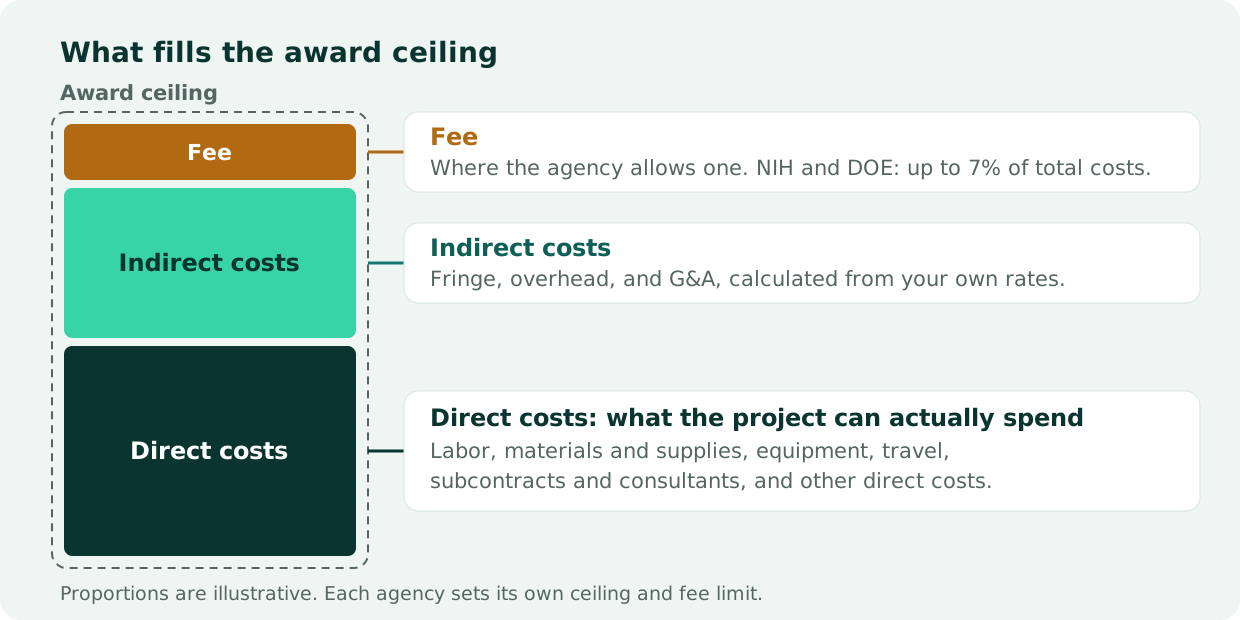
A Phase II budget has three layers: direct costs (labor, materials and supplies, equipment, travel, subcontracts and consultants, and other direct costs), indirect costs calculated from your own rates, and a fee where the agency allows one. Use the agency's ceiling to scope the budget, then build it line by line; you do not have to request the maximum. Give every line a basis a reviewer can check, and keep at least half of the research effort inside your company. Then build the budget in the same categories your accounting system records, because that is where a reviewer will compare it.
The practical takeaway: the award ceiling is not your research budget. The fee and your indirect costs come out of it first, and what remains is what the project can actually spend on labor, materials, travel, and subcontracts.
Size the budget from the ceiling
The U.S. Small Business Administration's SBIR budget tutorial recommends sizing a budget from the top down before building it: start with the maximum the agency allows, set aside the fee, remove indirect costs, and treat what is left as the money available for the research itself. It is a way to scope the budget, not a target: the budget itself is built line by line, and you do not have to request the maximum.
Its own example uses a $150,000 Phase I: a 7% fee ($10,500) and about $40,000 of indirect costs leave roughly $100,000 for labor, materials, project travel, and subcontracts. As the tutorial puts it, "If you thought you had $150,000 to do the Phase I project, you are incorrect."
The same logic applies to Phase II, with larger numbers. Each agency sets its own Phase II amounts within the SBA's limits (up to $2,153,927 without an SBA waiver, as of April 2026), so the solicitation is the starting point. The current limits and phase-by-phase differences are in SBIR Phase I to Phase II: How to Get Your Accounting Ready Before the Award.
The direct cost categories
Direct costs are the costs that belong to this project and no other. Agencies use slightly different forms, but most Phase II budgets ask for the same categories:
| Category | What goes in it | What supports the number |
|---|---|---|
| Direct labor | Each person or role on the project, the hours they will work on it, and their hourly rate | Payroll records for current staff; salary surveys or Bureau of Labor Statistics wage data for planned hires |
| Materials and supplies | Items the project consumes | Vendor quotes, catalog prices, or your market research |
| Equipment | Items bought for the project that outlast it | Vendor quotes, plus a reason the project needs the item |
| Travel | Trips the project requires, such as test sites, customer meetings, or program reviews | Purpose, travelers, number of trips, fares, and federal per diem rates |
| Subcontracts and consultants | Work performed by another company or an outside expert | A quote or letter with scope, hours, and rate |
| Other direct costs | Project costs that fit no other line, such as outside testing or lab services | Quotes or past invoices |
Fringe benefits, overhead, and G&A are not lines you estimate one by one. They come from your indirect rates, applied to their bases (more on that below). If your agency offers technical and business assistance, that request goes on its own line; see TABA: How SBIR Companies Can Use Technical and Business Assistance Funds. If you are unsure whether a cost is direct or indirect, see How to Classify Direct Costs on a Government Contract.
Direct labor: the line that carries the budget
For most SBIR companies, labor is the largest direct cost and the one a reviewer reads first. Build it person by person: who works on the project, how many hours, and at what rate.
- Rates have to be reasonable. The SBA defines reasonable as what a prudent person running a competitive business would be willing to pay, and expects negotiators to ask how you arrived at each rate. For people already on payroll, the payroll record answers that. For planned hires, keep the salary survey or wage data you used.
- The principal investigator needs real time on the project. The SBA tutorial warns against listing a principal investigator with so few hours that they appear to be on the project in name only. Some agencies set a minimum effort for this role, so check your solicitation.
- Every budgeted hour has to show up later as a recorded hour. On a cost-reimbursable award, labor is billed from timesheets, so the hours in the budget become hours your team will have to record, daily and in actual hours. Timesheets for SBIR Companies covers what that looks like.
Subcontracts and consultants: the 50% line
SBIR is meant to fund the small business itself, so the share of work you can send outside is limited. The Department of Energy's SBIR/STTR application guide sets out the standard limits:
| SBIR phase | The small business performs at least | Subcontracts and consultants, generally up to |
|---|---|---|
| Phase I | 67% (two-thirds) of the research or analytical effort | 33% of the total amount requested |
| Phase II | 50% (one-half) of the research or analytical effort | 50% of the total amount requested |
The percentages are measured on requested costs, including indirect costs and fee, attributable to each party. A Phase II budget with a large lab subcontract or several consultants can cross the line without anyone noticing, so run the check before the budget is final.
STTR works differently. Instead of capping outside work, it requires a partner: a research institution, such as a university, that performs part of the research. The small business must perform at least 40% of the work, and the research institution at least 30%. As with SBIR, the shares are measured on the requested costs, including indirect costs and fee, attributable to each party. The company also needs a written agreement with the research institution that allocates intellectual property rights.
Where the indirect rate and the fee fit
Indirect costs are not estimated line by line. They come from your indirect rates: each rate is a percentage applied to a base, such as direct labor or total costs, so when the direct costs in the budget go up, the indirect costs go up with them. In our worked example, an engineer paid $50 an hour actually costs the company about $107 an hour once fringe, overhead, and G&A are added. How to build and document those rates is covered in How to Build the Indirect Rate in Your SBIR Phase II Cost Proposal.
Two rules from the SBA's SBIR budget tutorial matter most here:
- Your rate has to be your own. Derive it from your books, never from another company or a university.
- The fee has to be requested. Agencies are required by law to allow a reasonable fee, but, in the tutorial's words, "you have to ask for it." The tutorial reports 7% as the most commonly accepted fee, and NIH and DOE allow up to 7% of total costs. Use the figure in your solicitation.
Estimate the way you record
A budget is also a promise about how your books will look later. If the proposal breaks costs into categories your accounting system does not track, there is nothing to compare it with. Paul Calabrese, a former DCAA auditor, named missing backup documentation as the biggest mistake he saw on the proposal side in one of our DCAA Ready sessions, and explained what a reviewer does with the detail in a proposal:
"The way they estimate should be the way that they recorded... within their system. So, you know, if you estimated a certain detail, well, government says, I want to see that detail historically in your accounting system so I can compare the two."
Paul Calabrese, former DCAA auditor
In practice, that means:
- Use the same categories in the budget and in the chart of accounts. If the budget has a line for outside testing, the books should have an account for it. See Cost Pools Explained.
- Give each award its own project or class, so its actual costs can be pulled on their own.
- Base estimates on history where you have it. Phase I actuals are the best evidence a young company has for Phase II labor hours, material costs, and travel.
Write the budget justification
Most agencies ask for a budget justification, a short narrative or table explaining each line. A reviewer should be able to follow every number back to its source without asking. For each line, state:
- What it is, and why the project needs it.
- The quantity: hours, units, trips, or months.
- The price, and where it came from: payroll, a quote, a catalog, per diem tables, or a survey.
- The calculation, quantity times price.
- Any assumption, such as a planned hire or a price increase, stated as an assumption and kept separate from actual figures.
For travel, show the purpose, who travels, how many trips, and the cost basis. On contracts, the federal rules on travel costs (FAR 31.205-46) limit lodging, meals, and incidental expenses to the federal per diem rates, so price trips within the continental United States with the GSA per diem rates. How travel is classified in the books is covered in How to Classify Travel Costs on a Government Contract.
Common mistakes in a Phase II budget
- Treating the ceiling as research money, and running out once the fee and indirect costs are taken out.
- Borrowing an indirect rate from another company, a university, or an industry rule of thumb.
- A principal investigator in name only, budgeted for too little time to be credible.
- Sending too much work outside, past the 50% limit on subcontracts and consultants in SBIR Phase II.
- Not asking for a fee, or using it to fill whatever gap is left in the budget instead of requesting a set percentage.
- Lowballing to look competitive. A rate shaved below actual cost can be capped for the life of the award. See What Is "Buying In" in Government Contracting?
- Budget categories that do not exist in your books, which leaves nothing to compare the estimate against.
After the award: the budget becomes your baseline
Once the award is signed, the budget stops being a proposal and becomes the yardstick for spending. Track actual hours and dollars against it as you go, not at the end of the period of performance, so overruns show up while there is still time to act. If the Phase II is cost-reimbursable, you will also bill during the year on provisional indirect rates and settle against actual rates later. How that works is in Getting Paid on a Cost-Reimbursable SBIR Phase II.
How WiseCost fits
The budget is still yours, or your CPA's, to put together. What WiseCost gives you is the real numbers to build it from, and a way to follow it once the award arrives.
- Real hours from Phase I. Daily timesheets, approved by a supervisor, show how many hours each person actually worked on each project and what those hours cost, the best starting point for Phase II labor.
- Your own rates. WiseCost calculates fringe, overhead, and G&A from your QuickBooks Online books, with the transactions behind each rate, ready to back up the proposal.
- A total budget for each award. Once the Phase II starts, you can set its total budget in hours or dollars and follow actual spending against it.
FAQ
The Bottom Line
A Phase II budget is credible when every number has a source and the categories match the books. Use the ceiling to size the budget, take out the fee and your own indirect costs, and build the direct costs line by line with quotes, payroll, and per diem behind them. Keep at least half the research in-house, ask for the fee, and budget in the categories your accounting system already records. The same records that support the proposal will be the ones you track the award against.
If your Phase II will be cost-reimbursable, you can run our free DCAA Readiness Self-Assessment to see whether your accounting system is ready for it.
Official Sources
- Scoping an SBIR budget, reasonable labor rates, principal investigator effort, and the fee: SBA, Accounting and Finance Tutorial 1
- SBIR and STTR limits on work performed by third parties: DOE SBIR/STTR application guide, R&R Subaward Budget
- NIH SBIR/STTR fee: NIAID, SBIR performance standards and fee guidance
- DOE SBIR/STTR fee: DOE PAMS budget help
- Travel costs on contracts: FAR 31.205-46 and GSA per diem rates