Bid & Proposal· · 10 min read
How to Calculate Your SBA Size From Your Books
SBA measures size by average annual receipts over five years or average employees over 24 months. How each number is calculated, where it comes from in your books, and what SBA's 2026 size standards proposal could change.
Every time you bid on a small business set-aside (a contract reserved for small businesses), you certify that your company is small for the industry the contract is assigned to. That certification sits in SAM (the System for Award Management, where federal contractors register) and in each offer, and it is easy to treat it as a checkbox. The number behind it comes from your own records, and in 2026 it matters more than usual: the Small Business Administration (SBA) has proposed rewriting the size standards, and many industries would switch from measuring receipts to measuring employees.
This guide is for owners and bookkeepers who want to know their real number before they certify, and before the proposal becomes final.
The short answer
SBA measures size in one of two ways, depending on the industry code of the contract:
- Average annual receipts: your total receipts over your last five completed fiscal years, divided by five (13 CFR 121.104).
- Average number of employees: the average of your headcount in every pay period of the preceding 24 completed calendar months, counting part-time and temporary staff the same as full-time (13 CFR 121.106).
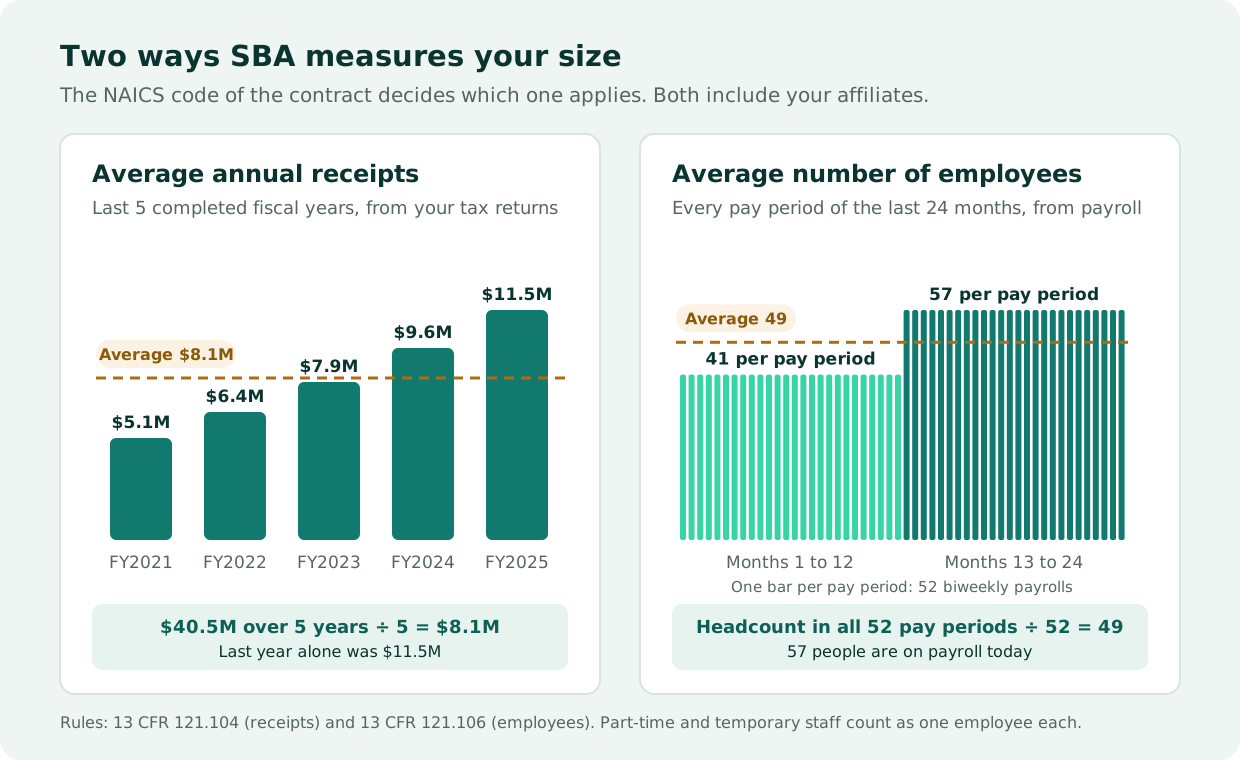
Both numbers include your affiliates: businesses that control you, that you control, or that are under common control with you, as SBA defines affiliation in 13 CFR 121.103. You compare the result with the size standard for the NAICS code (North American Industry Classification System, the six-digit industry code) assigned to the solicitation. Under 13 CFR 121.404, what counts is your size on the date you submit your initial offer that includes price.
Your size is a calculation, not a self-description. Receipts come from your tax returns and employees come from your payroll records, so both can be checked.
How SBA calculates average annual receipts
SBA defines receipts as all revenue from any source, reduced by returns and allowances. In practice, the regulation says receipts are generally "total income" plus "cost of goods sold" as reported on your federal tax return (Form 1120, 1120S, 1065 or Schedule C, depending on your entity).
Three details catch government contractors:
- You cannot subtract pass-through costs. The regulation says subcontractor costs and reimbursements for purchases made at a customer's request may not be excluded. If you bill $2 million a year of subcontracted work, all of it counts toward your receipts. On a set-aside, that same subcontracted work is also limited by the limitations on subcontracting.
- The exclusions are short. Only net capital gains or losses, taxes collected for and remitted to a taxing authority, transactions between you and your affiliates, and amounts collected for others by a few agent-type businesses (such as travel agents and freight forwarders) come out.
- Tax returns are the source. SBA relies on the federal returns filed on or before the date you self-certify. If a year that must be counted has no return filed yet, SBA uses other information, such as your regular books of account or audited financial statements.
An example
A company with five completed fiscal years adds up the receipts on its five tax returns and divides by five:
| Fiscal year | Total income plus cost of goods sold |
|---|---|
| 2021 | $5,100,000 |
| 2022 | $6,400,000 |
| 2023 | $7,900,000 |
| 2024 | $9,600,000 |
| 2025 | $11,500,000 |
| Total over five years | $40,500,000 |
| Average annual receipts | $8,100,000 |
Its size number is $8.1 million, even though it billed $11.5 million last year. Because the average looks back five years, a growing company stays small on paper for a while after its revenue passes the standard. The reverse is also true: one very large year stays in the average for five years.
If you have fewer than five years in business
SBA turns your receipts into a yearly figure based on the weeks you have been in business: total receipts since you started, divided by the number of weeks in business, multiplied by 52.
For example, a company that has been in business for 166 weeks (a little over three years) and has $9,960,000 in total receipts in that time:
- $9,960,000 ÷ 166 weeks = $60,000 per week
- $60,000 × 52 weeks = $3,120,000 in average annual receipts
The same weekly method applies when one of your five years is a short tax year, for example the year you changed your fiscal year end.
How SBA calculates the number of employees
SBA counts everyone employed on a full-time, part-time or other basis, including people supplied by a temporary employee agency, a PEO (professional employer organization) or a leasing company. Volunteers with no compensation are not counted.
The count is an average: the number of employees in each pay period over the preceding 24 completed calendar months, divided by the number of pay periods. A part-time employee counts as one, the same as a full-time employee. If you have been in business less than 24 months, the average covers the pay periods you have been in business.
An example
A company runs payroll every two weeks, which is 26 pay periods a year, so the last 24 months include 52 pay periods. It had 41 people on payroll for the whole first year and 57 for the whole second year:
| Period | Pay periods | People on each payroll | Headcount added up |
|---|---|---|---|
| Months 1 to 12 | 26 | 41 | 1,066 |
| Months 13 to 24 | 26 | 57 | 1,482 |
| Total | 52 | 2,548 | |
| Average number of employees | 2,548 ÷ 52 = 49 |
The company has 57 people on payroll today, and its size number is 49.
Because the count goes pay period by pay period, the records that decide your size are your payroll registers, not a headcount on the day you bid. A company that adds people quickly can stay under an employee standard for a while. A company that uses many part-time staff can cross it sooner than it expects.
Where each number comes from in your books
| Measure | Official source | Where to check it during the year |
|---|---|---|
| Average annual receipts | Federal income tax returns for the last five completed fiscal years (13 CFR 121.104) | Your QuickBooks Online Profit and Loss by fiscal year, reconciled to what was reported on each return |
| Average employees | Employees in each pay period of the preceding 24 completed calendar months (13 CFR 121.106) | Payroll registers from your payroll provider, one headcount per pay period |
| Affiliates | Each affiliate's own receipts or employees, added to yours | Each affiliate's tax returns and payroll records |
The calculation is simple once the inputs are clean. The work is in keeping them clean:
- Close each fiscal year in your books before the return is filed, so the revenue in QuickBooks Online matches the return. Differences between book revenue and tax revenue are normal, and the return is what SBA uses.
- Keep revenue that passes through to subcontractors in revenue. Some companies net it out in their own reporting; SBA will not.
- Export a headcount for every pay period from your payroll provider, including part-time, temporary and leased staff. Running Labor Distribution with Gusto, ADP or Paychex covers what each provider exports.
- Recalculate before each bid on a set-aside, because both averages move as time passes: a new fiscal year drops your oldest one, and each new month moves the 24-month window.
To run the numbers with your own figures, use the calculator below. Pick the measure your NAICS code uses, enter your figures, and add the size standard from the solicitation to compare.
What SBA's 2026 proposal could change
On August 20, 2026, SBA proposed replacing its current size standards, which cover 978 six-digit NAICS industries plus 18 exceptions, with 338 standards set at the four- and five-digit NAICS level. The proposal also removes all the current size standard exceptions. Under it, 208 standards would be based on employees and 129 on receipts. SBA's revised methodology defaults to employee-based standards wherever it has discretion.
SBA estimates the change would make about 114,541 more businesses small, including about 37,002 firms that held federal contracts in fiscal year 2025, and that fewer than 200 businesses would lose small status. It proposes not to lower any size standard that keeps its current measure.
For your books, the practical change is the measure. If your industry moves from receipts to employees, the number that decides your status stops being five years of tax returns and becomes 24 months of payroll registers. A professional services firm with high revenue per person may become small. A firm with many lower-cost or part-time staff may find the employee count harder to stay under.
The proposed standards for each industry are in the table published with the rule, in the Federal Register (91 FR 53741). Comments are due November 20, 2026, under docket SBA-2026-0199 on regulations.gov. We track the proposal's status in GovCon Updates. Until a final rule takes effect, the current size standards apply.
How WiseCost fits
The size calculation stays with you or your CPA, from your tax returns and payroll registers. What WiseCost adds is the labor record behind your headcount: daily timesheets for every employee, labor distribution posted to QuickBooks Online each pay period, and a Labor Distribution report you can run by payroll period. If your industry moves to an employee-based standard, those are the records that show who worked for you, and on what, in each pay period.
FAQ
The Bottom Line
Your SBA size comes from two records you already keep: five years of tax returns for receipts, and 24 months of payroll for employees. Know which measure your NAICS code uses, calculate it the way the regulation does, including subcontractor costs and affiliates, and recalculate before each set-aside bid. If SBA's proposal becomes final and your industry moves to employees, your payroll records by pay period become the number to watch.
Want your labor and payroll records ready for anything an agency asks? Take the free DCAA Readiness Self-Assessment, or start a 14-day free trial of WiseCost on your own QuickBooks Online.