Bid & Proposal· · 6 min read
Building Your Rate as a Solo GovCon Consultant
Leaving a large contractor to consult on your own? Here is how to build a defensible hourly rate as a sole practitioner: base labor rate, fringe you now pay yourself, payroll taxes, and the G&A structure to reserve before you grow.

When you leave a large contractor to consult on your own, the number in your head is usually the market rate you know you can command. To build a rate you can defend, you work in the other direction: base labor rate, fringe, payroll taxes, and a G&A structure to reserve before you grow.
When you leave a large contractor to consult on your own, the number in your head is usually the market rate you know you can command, say $150 an hour. To build a rate you can defend, you work in the other direction: start from a base labor rate (your salary target divided by the hours in a work year), add the fringe you now pay for yourself, layer in payroll taxes, and reserve a G&A structure for the proposal and admin time you will spend running the business. The government wants to see what is behind the $150, not just the $150. This is drawn from our DCAA Ready webinar series, with Paul Calabrese, a former DCAA auditor.
This is the most common path into government contracting, and the least documented. Many strong consultants come out of a large prime, know their billing rate, and have never had to build it from scratch, because the big company did that for them.
Start with a base labor rate
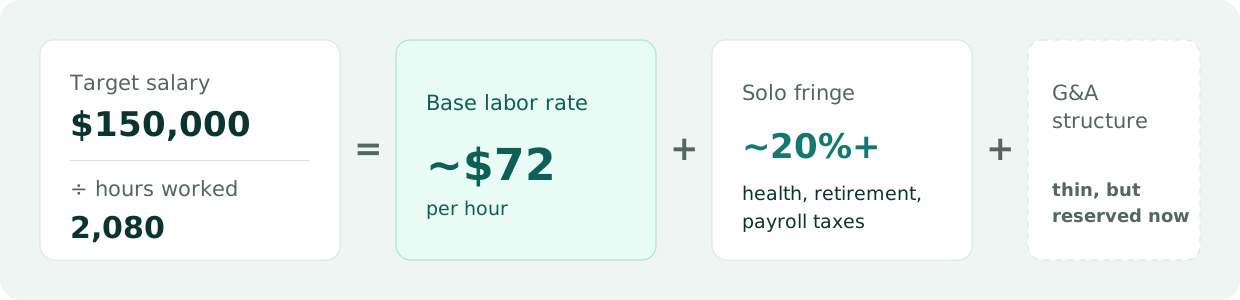
Your base labor rate is your target annual salary divided by the hours you work in a year. The standard full-year convention is 2,080 hours (52 weeks at 40 hours).
If your target is $150,000 a year:
$150,000 ÷ 2,080 = about $72 per hour
That $72 is your base direct labor rate. It is not your bill rate. It is the floor you build up from. Notice it is already far below the $150 market number in your head, and that is the point: the space between $72 and $150 is the fringe, the G&A, and your profit that the market rate was quietly covering all along.
If the work spans multiple years, add an escalation factor for inflation before you go further. A 3% annual escalation is the figure most people use.
Add the fringe you now pay yourself
At a large company, fringe was invisible: health insurance, retirement, and payroll taxes came out of a system you never saw. On your own, you are the system. Your fringe now includes:
- Health coverage. A marketplace plan, unless a partner or spouse can cover you.
- Retirement. A SEP or similar plan lets you set aside pre-tax savings within IRS limits.
- Payroll taxes. Budget at least 10 to 11% for simplicity, recognizing there are thresholds where portions start and stop.
Add these up and a solo fringe rate often lands a little above 20%. It is not the polished number a large firm carries, but it is real, and it belongs in your rate.
Reserve a G&A structure now, even if it is thin
Here is the part most sole practitioners skip. You will not spend all your time on billable client work. You will spend real hours on proposals, on talking to consultants, on the bookkeeping and admin of running the business. That time has to live somewhere, and that somewhere is a general and administrative structure.
You may not need a full overhead pool yet. Overhead becomes relevant when you are managing multiple contracts and people, usually past the 10-person mark. But even solo, you should stand up at least a fringe pool and a G&A pool, even if they start as placeholders. Structuring the accounts now, using a standard GL series where G&A commonly sits in the 7000 or 8000 range, means the framework is already there when you grow into it. Our chart of accounts guide shows how to set that up in QuickBooks Online.
What to use when you have no history
A single practitioner does not have a full year of accounting history to support estimates, which the government usually wants. Two things help.
First, if you are leaving to support a former employer or a prime, that relationship gives you a statement of work and an hour estimate. Say the prime can offer you 700 hours. That is not a full year, but it is enough to anchor a rate: take your $72 base and multiply by the hours you can reasonably expect.
Second, be honest that early pricing is based on the work you hope to get, not on sophisticated forecasting, and document it that way. As Paul Calabrese described the typical exit in our session, the prime you are leaving often does not want to lose you, because a cleared, experienced person is hard to replace, so the first contract frequently comes out of that conversation. Build your rate around it, and keep the backup.
The full picture, scaled down
The build is the same one a larger firm uses, just lighter. Direct labor, then fringe, then (eventually) overhead, then G&A, then fee. The pillar guide, how to build rates that win government contracts, walks the complete stack with a worked example. As a solo consultant you may collapse overhead into G&A at first, but the logic does not change. Figures here are illustrative, not benchmarks.
One caution as you set the number: if you grow past yourself and take on people, a rate you set too low stops being sweat equity and starts being a real loss. See what is buying in before you underprice to land the first award.
Build compliant habits before the first audit
You do not need an ERP to start right. WiseCost connects to the QuickBooks Online you already use and adds compliant timekeeping and labor distribution, so the base rate, fringe, and G&A you reserve today are tracked in a system that scales as you add your first employees. Its Pre-DCAA mode is built for exactly this moment: getting compliant before the first award, not after.
FAQ
WiseCost offers a 14-day free trial, no credit card required. You can also run our free DCAA Readiness Self-Assessment, or book a demo to see how it works as you add your first hires.
Based on the DCAA Ready webinar series, Session 04: Bid & Proposal — Building Rates That Win Contracts, featuring Paul Calabrese, a former DCAA auditor (GRF CPAs & Advisors). Figures are illustrative and not benchmarks.